Showing posts with label #maine. Show all posts

Time Lapse - Beaver Pond Reflections


Time Lapse Video (First attempt so pardon the quality) of blocking in Beaver Pond Reflections


First pass complete - 45 minutes in


Final Painting


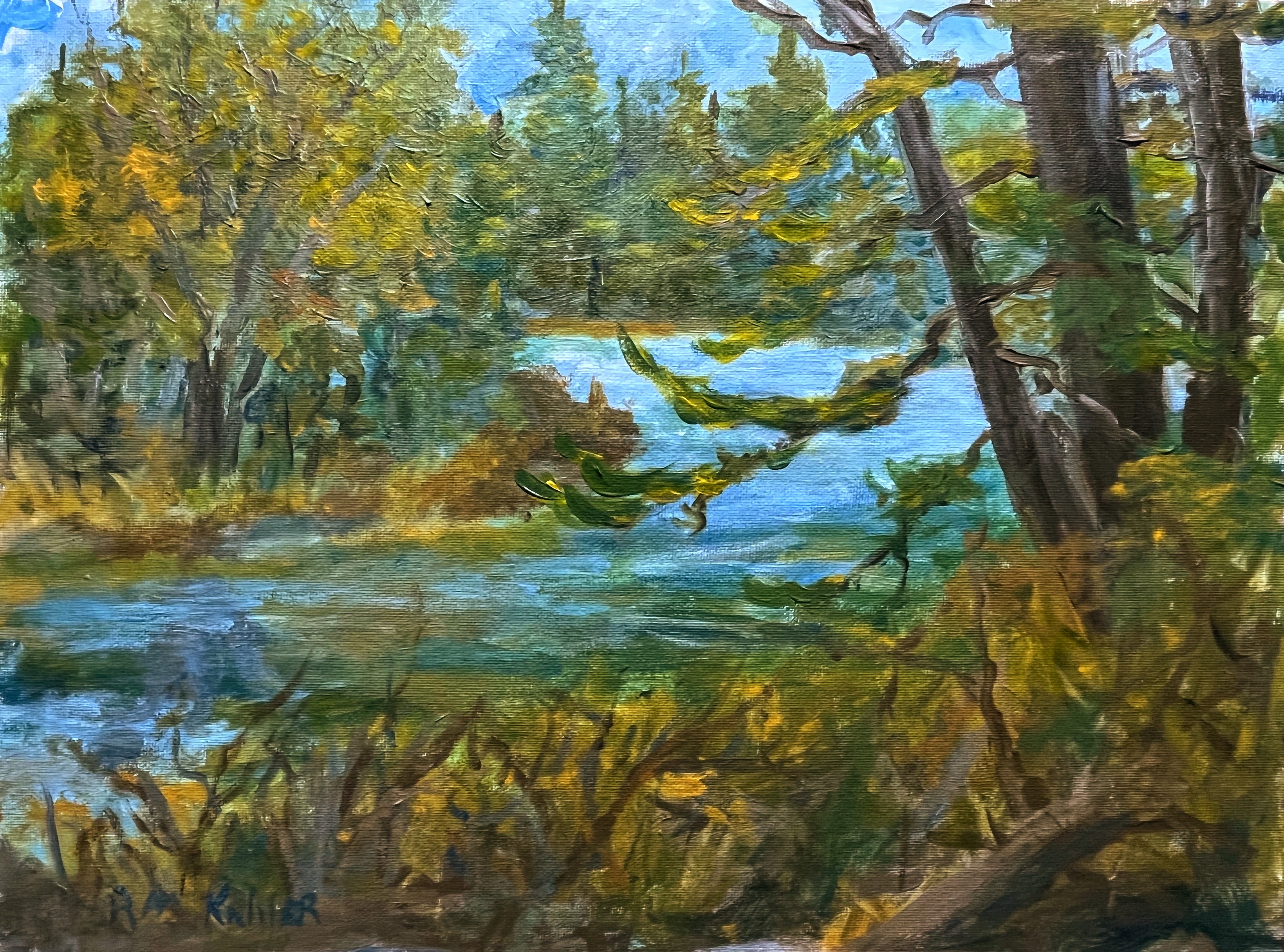
Beaver Pond Reflections


Beaver Pond Reflections - Crawford Maine
Acrylic 12" x 16"


Below left was the painting before final adjustments for color and composition.  Subtle differences in the height of the background trees.  I developed the trees on the island and the shape of the island a bit more and, lastly, added some detail and color contrast to the pond, reflections, and foreground.

I particularly enjoyed painting the foreground.  When exploring the Maine streams and woods in the summer or fall, you will often see trees and driftwood deposited by the spring runoff  high among trees or high up on river banks.  That was the inspiration for the tree in the lower right foreground.   A small thing, an incidental accident, almost unconscious but as soon as I made the first brushstroke - there it was.  


The other challenge I run into when painting is to find the proper balance of detail and impression.  I prefer letting the imagination fill in detail whenever possible.

While reading a book of Rusty Heurlin's with his notes in the margins - he had underlined and noted the importance of simplification in his work.  "Simplify, Simplify, Simplify....   Put in only what is necessary in a picture and no more."

Easier said than done but the experimentation is fun and remember - there is almost nothing that can't be undone!


Process versus Spontaneity


Acrylic 12" x 16"

This is an update on the progress of Beaver Pond - Crawford.   This represents about 45 minutes of work with Acrylic directly on canvas to block in the composition and then about 10 minutes on another day to begin to zero in on correcting colors.  (2nd pass)

My favorite type of painting remains on location painting, starting and finishing in one session - generally about two to two and a half hours.  However,  when I don't have the time to paint on location I'll use on location sketches and trips as inspiration.  I've documented this elsewhere if you are interested.

In general my method in these types of cases for acrylics is

Compositional Sketches (very loose - mostly line drawings)
Larger Charcoal Sketch to work on values

Then onto working with Paint:

1st Pass  Covering the Canvas in Paint
                    Blocking in the composition rapidly
                    While attempting to get colors and values correct at this stage - but 
                     not worrying if the colors are off 

2nd Pass  Fine tuning painting for both color and composition

Set aside for a few days (or months or years in some cases)

3rd Pass (if painting is not completed) further refinement


I resisted developing a system or process for years.  I just wanted to get out and paint.  While that helped me develop as an artist in many ways, it was also frustrating for me as I often spent as much time searching for what I needed, often wasting what little time I had for painting.  

I've slowly come to realize that even on a day when nothing goes as planned with a painting, if the results are horrible and in no way reflect what I am trying to capture - it's fine.  I still have learned something.  

It took me years to establish a system that works for me with the time I have that still allows me to maintain a sense of spontaneity and excitement when I'm painting.

I also have a "go bag" (three actually) for Watercolor, Acrylic, and Charcoal in addition to my main paintbox which I will switch out between all of the above and oil paintings.


Fall Reflections by Elmer Ham


Watercolor by Elmer L Ham

I love the light and the sense of atmosphere captured by Ham in this watercolor painting.  While this is likely a painting executed in studio - it clearly demonstrates to me the lifetime Ham spent studying nature and painting and sketching on location.

This is most likely a Maine or Massachusetts scene by Ham.  I've seen landscapes and florals executed by Ham in Watercolor, Pastel, Oil, and Pencil.  

Working as a sign painter and painting outdoor advertising murals allowed Ham to pursue his love of painting throughout his life.  Ham exhibited paintings in Boston, Provincetown, and Springfield Mass, and Ogunquit and York Maine as well as in competitions and local venues throughout New England and California.


Sunset Paris Hill Pass 2


This is today's pass with Gouache over the charcoal sketch below.  The Focus was mostly on the sky and distant mountains.  The house had a particular shade of blue which is work for another day.  Feels great to be painting again.


"Just Paint"

Charcoal Compositional Sketch
18" x 24"

I fell into my bed - exhausted. Drifting off.... "Just paint" 

It could have been the tinnitus, but the voice was persistent. "Just paint" 

I dragged myself out of bed and stumbled down cellar to my studio where I had previously taped four blank note cards to my easel. 

 For a host of reasons, I've been unable to paint for quite awhile - too long for my liking. But where to start? "Just paint" 

Many years ago on Paris Hill a particularly striking sunset looking west from the village green beyond Hannibal Hamblin's house to the mountains beyond was seared into my mind. It was breathtaking.... I soaked up every minute of that sunset. 

 "Just paint" 

 I did a few quick Pen and Ink compositional drawings and then broke out some gouache and did these four quick compositional studies.   From the top left to right - sketches 1,2, and 4 were closest to the actual scene as it was. Three was a combination of the scene with a cloudscape at sunset from a different time and location. 
The color was way off (off-full you might say) but for my purposes it didn't really matter. I just needed to push some paint around and work out a few ideas that though they would not be exact representations of the scene but that would capture the feelings it provoked in me. 

In looking at the sketches - a combination of numbers two and three let to this larger charcoal sketch (18" by 24") which will be the basis for a finished painting


These are all quite loose for sketches, but each one informs me a bit more and helps me catch errors in composition before being heavily involved with the final painting.  

I thank God I'm no longer held captive by the thought that each and every painting and drawing must be perfect and "finished."  It relieves so much unrealistic self imposed stress to not make any "mistakes."  I wish I'd figured that out well before my mid 40's 

Each and every effort informs the next one and so on.

Just Paint!


With All Thy Might


With All Thy Might
Acrylic 12" x 16"


I enjoy times at the coast when the weather is such what the roar of the ocean and wind drown out the concerns of the day.  These walks and painting sessions bring to me a deep sense of peace that is both as indescribable as it is increasingly rare in the frenetic pace of our daily lives

This subject, like many of mine, is a combination of a number of places along the Maine Coast and it's islands.  The bulk of the painting was completed in one day.  I'd really been fascinated with the ever changing cloud formations.

The original pass at this subject is below.   I knew that the wave was not correct, but I wasn't sure what I wanted to do with it - so I simply set it aside..


Sometimes the time in between first pass and second is less than a day.  At other times - years.  In this case it was the latter.  

I added more movement to the wave, with the center pushing forward more quickly.  I also added a little more contrast to the tall grass and a few hangers on - leaves on the saplings.  I'm always amazed how nature finds a way - in this case a few leaves in an exposed wind and surf driven spot remain attached even through the first snow.

.
#robertkahlerlandscapepainting,#acrylic, #maine, #ArtForSale, #WorkingMethods, #seascape

Above the Mill Pond


Above the Mill Pond
Mixed Media - Acrylic and Oil
12" x 16"


This painting began on a Sunday afternoon drive.  I did some on location Pen and Ink sketches and then explored the area as much as time allowed.  The small watercolor sketch below was done in studio and just a quick experiment to see how I might capture different aspects of the area in one painting.


Below is the first pass at the subject with Acrylic paint.  I enjoyed the exercise of altering the perspective of the subject.  I also wanted to simply suggest the background bank of the mill pond rather than painting it directly.  Although this "draft" of the subject did capture some of what I was trying to achieve, it wasn't complete in my mind.  I set the painting aside and moved onto other subjects - which is something I do either consciously while I let things simmer in the background of my mind.  The more I paint and observe, the more I have to draw on for the next subject.


Eastport Shades of the Past


Shades of the Past
Gouache on card stock

I've been experimenting with small painted sketches, working out different ideas for subjects including utilizing differently cropped perspectives which keeps the subject focused yet implies a lot of distance outside of the view.

This scene was taken from an on location watercolor I completed a few summers ago in Eastport, ME.  I was struck by the play of shadows on the sunlight face of an abandoned factory just off main street.

As a student of history, I could just imagine the harbor filled with three and four masted schooners in its heyday and I decided to alter the pattern of the shadows on the factory to represent that history.


#robertkahlerlandscapepainting #workingmethods #sketchingwithpaint #eastport #maine


Island's Edge


Island's Edge
Charcoal on Paper 12" x 18"

This is my latest piece, inspired by many trips to Long Island, Maine and along the Maine coast in general.  The more frequently I draw, the more I approach drawings like a painting.  Not just in terms of composition, but also in terms of technique and approach.  When my drawing becomes more free, I begin to experience the "happy accidents" that occur in watercolor painting as well.  Where the effects of nature, the emotions you are feeling, appear almost unconsciously or accidentally.

I've been paying more and more attention to sky.  Each day , each few minutes actually,  brings its own abstract painting into being.  The ocean, even as a storm approaches or in full storm, has always brought a sense of peace to me.  It's vastness and power always serve to put things into perspective for me.  Problems that seemed so vast, almost insurmountable, vanish in the spray and thunder of the ocean.

Is it Done or Is it Finished?


These two photos of two of my most recent paintings give a better sense of the size of the water color sketches to the finished work.   For these two acrylics, the sketches are about 1/4 the size of the finished work.

With the large watercolor I did  of the Amonoosuc River, the ratio was more like 7 1/2 to 1.  At this point, I don't do a detailed scale down or up from sketch to finished painting, it is more just a part of the process.  Trying to keep this as simple as possible for quick and efficient sketching in an attempt to capture the moments which catch my attention.

I'm quite motivated by the idea of capturing the different moods of a subject, and even imagining them based on earlier observations of nature.  Both of these paintings are realistic subjects - they do exist, but in imaginary perspective for the old mill pond, and imaging a winters evening full moon light at a local farm.   I really enjoyed these different exercises in the studio.  Working on location remains my first joy in painting, but studio work is gaining in its standing and enjoyment for me.  

I also try to keep the advice of two well known and highly successful artists front and center as I paint.  John Stobart advised putting only as much detail into a sketch as would be needed to execute a finished painting later.  This was to avoid "copying" even one's own work and maintaining room for the spark of creativity.

The late Bob Harris (Robert George Harris) was very encouraging to me through our correspondence and phone calls.  One of my favorite quotes of his is:  "It's important to know when a painting is done before it is finished."  

I also remember vividly the original illustrations by N.C. Wyeth and Howard Pyle on display at the Farnsworth Museum in Rockland, Maine.  The paintings were monumental in scale, composition, color, and use of limited detail.  They knew how to lead your eye where they wanted it to go.  A large area of background scumbled in with virtually no detail in no way diminished these paintings.  On the contrary, the contrast made the paintings even more powerful.  You really had to be on the lookout to even notice these techniques.


Early Spring Evening

Early Spring Evening
Acrylic on Canvas Board
12" x 16"

This is the first studio evening painting I've attempted.  I enjoyed the challenge of muting the colors down, while still capturing the sense of atmosphere on a moonlight night reflecting off the silo, house , and late spring snow.

The inspiration for this painting is a farm I pass by daily on my way to work.  The elements of this painting are all there, just not in the location that I've included them.  I've included a couple of water color sketches below which were the beginnings of working out ideas for this painting.


The watercolor sketch on the left was impression one of a scene toward dusk.  The sketch on the right was a second iteration, which moved the trees behind the house to add emphasis to the house.  I was also experimenting with corn in various stages of decay in the foreground.  

Just quickly looking at these sketches, I can easily see 4 to six different paintings, including a night scene with the snow - which is what I decided to paint.  Below is the first block in, where I was trying to accomplish two things.  One, not to waste paint from another painting I'd just finished (The Yankee in me) and to cover the canvas to make it more workable.  Two I wanted to rough in the composition.


I didn't attempt to block in the tones of evening in the sky, in part, because my one attempt at painting at night (so far) proved to be too dark when examined in the light of day.  I find it's easier to go darker than to lighten up a painting.  I did intentionally block in the dull colors as the base for the hay/ field in the finished painting.

I added the building outline in making one significant change  I moved the house in toward the center and changed the direction of the house to lead the eye into the picture.  I first sketched it in in charcoal as I did in the watercolor sketches - but it instantly struck me as wrong and I changed it to the final composition.  I didn't bother to sketch in any more details as I had the sketches and the impressions from observation to go from and I enjoy continuing to compose as I paint. #pushingpaintaround

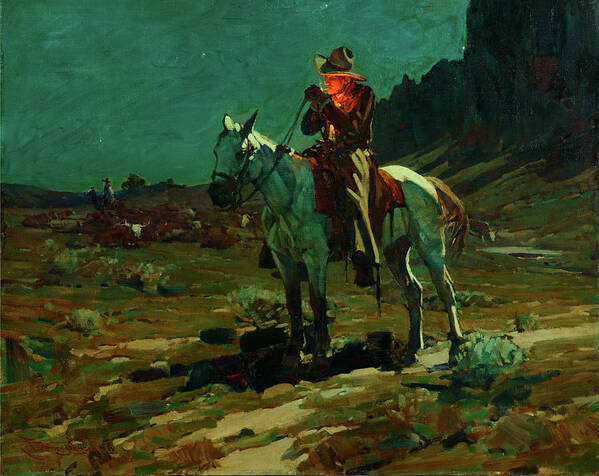
One painter whose evening painting (nocturnes) I admire is Frank Tenny Johnson.  His western nocturne's take my breath away.

Night Time in Wyoming Poster by Frank Tenney Johnson


Above the Old Mill Pond

Above the Old Mill Pond
Acrylic 12" x 16"

This painting was based on Plein Air sketches in Pen and Ink and the watercolor sketch done later in studio.  The perspective is imaginary, as though looking down from a high mill tower.  I wanted to find ways to include what was at the scene in one picture that you could see, just not all at once.

The mill is long unused.  Part of the building being used for apartments.  Part of it collapsing.  Part of it long collapsed.  The mill pond still exists, though the dam is slowly failing.  I broke the edge of the building in the foreground to allow another example of distance as well as the birch tree on the right for the same reason.

I was pleased at how this composition came together and I enjoyed trying to convey a sense of space without having any actual "sky" in the painting.  I plan to go back to this location to do an on location painting of the dam itself, before it is gone.

You may have noted that there is no chimney in the finished painting.  There wasn't actually one there, I was just experimenting in the watercolor.  I also adjusted the angle of the mill building to lead more into the mill pond rather than across it as in the watercolor sketch.

Above the Old Mill Pond Study

Watercolor Sketch - Above the Old Mill Pond

As of late, I've become more and more interested in cropping compositions differently, almost approaching the abstract.   This quick watercolor sketch is based on reality, but not exact.

I'd gone out on a Sunday morning sketch trip and revisited on old mill I'd sketched before in pen and ink.  I sketched the building from the side of the road from a much lower perspective.  The old dam, in the lower right of the composition, was also another subject of interest for me.   The mill pond was was also a point of interest that could not be seen from my original vantage point.

These sketches also took place in the winter.  I decided to imagine what the scene would look like in the fall with the reflections of trees and then how I could alter the perspective and still be true to the mill and the old dam.  So what started as a subject focused on the mill in winter, turned out very differently.  

I enjoy the process of when I am working on a painting or even when writing, that I have a clear idea of where I want to go, but the painting develops a will of its own.  This was a quick watercolor sketch that I will definitely expand into a larger more finished work.

There was an older mill across the street that I'd hoped to paint and sketch, as there were many interesting angles and designs in the decaying mill, but the last time I went back to sketch, the mill had been torn down.

Breakers


Breakers - March
Oil on Canvas Board 12" x 16"

I've always been fascinated by the ocean.  This oil on canvas is drawn from memory of countless hours watching the ocean since I was a child - particularly along the Maine Coast.  There are so many different rhythms, colors, smells, and sounds to the ocean - that I believe you could paint in the same spot every day for years and never have two paintings be identical.  This spring and summer I am going to make a concerted effort to paint on location at the coast.  Just need to pick my spot.

Swift River #2

Swift River #2
Acrylic on Canvas Board
12"X 16"


This painting was done from an on location sketch done in acrylics more than twenty years ago.  It was a grey spring day and quite cold.  I set up in the middle of a small bridge built for lumber access.  By the time I was done with the painting I was freezing and my hand was so stiff I needed to use my left hand to take the brush out of my right hand.

One of the things that I enjoy the most about painting on location is how lost I become in a place and time.  The paintings bring me back to that moment in time.  And even when the moment is well beyond my skills and experience, I find that so much more is taken in than I realize, and it often comes out later as my skills and experience catch up with my chosen subject.

One of the challenges of this type of day and subject is that without much sunlight, shadows are minimized and the key is similar throughout the painting, making the effect of distance harder to achieve.  I'm likely to do a couple different versions of this composition based on my observations of other similar locations. 

One will be a scene with mottled sunlight filtering through the trees.  Another a winter scene. 


Sunset, St. George River

Sunset, St. George River
Watercolor on Paper
9" x 12"

This was the scene (varied slightly) at the rear (or front depending on your perspectice) of the Olsen cemetery looking out at the St. George river.  Sometimes I need to be clubbed over the head before I decide on a final composition.

This pen and ink composition sketch (4" x 5") had the island as was, smack in the middle of the view - preventing the eye from going into the picture.    Then I did a quick watercolor sketch (not pictured) from memory and this small sketch - moving the island to the viewers right.  Two things stood out to me - one the move to the right helped but not how I'd intended.  I really wanted to emphasize the light in the whole in the tree and this composition failed to do that.   I then noticed that I'd put the island smack dab in the middle of the watercolor (if not the view between the trees).  

Still that "failed" watercolor brought me back to the moment that had impressed me weeks before.  I altered the orientation of the paper and produced this watercolor this morning.

Sunset St. George River  WC  9" x 12"

Wyeth Country - Cushing Maine


I dropped off three paintings to be evaluated for an upcoming juried show in Damriscotta.  I used this opportunity to take a trip to Wyeth country - specifically Cushing and the Olsen house (closed for the season).

It was late in the afternoon, but an unseasonable warm and sunny day for mid winter.  I had no real desire to paint the Olsen house, that was one of Andrew Wyeth's realms.  I was more interested in paying my respects to the artist and its now long famous inhabitants.  We drove down the dirt road to the small cemetery perched on the oceans edge.  I was reminded of NC Wyeth's painting "Here, there be Giants." as the afternoon shadows lengthened and the brilliant orange sunset settled in.  After paying my respects, I explored before the light disappeared.

Below are quick, and small, pen and ink sketches of Andrew's view of the Olsen house and a view of the ocean at the far end of the cemetery.  (notes in the margins).


I tried to augment my notes of color with an oil pastel sketch - that did not end well.   I also executed a quick water color study - intentionally keeping this loose to try to catch the atmosphere.  The reflections and shadows on the ice were more than I felt I could capture in watercolor so I decided to use this study as the basis for an oil painting.

I plan to do both of the Pen and Ink sketches above as finished paintings once I work out the compositions more.

Below is the oil I began today - Sunset on Ice (11" x 14")


I had originally planned to do more, but I quite like the simplicity of this composition so I'm just going to let it sit for a bit before adding more or simply signing it as is.


Winter 4-6

Winter Paintings 4 - 6

These three paintings were not completed on location, but resulted directly from on location observations.  In each case, I went home after visiting a location and completed these drawings and paintings from memory.

Fort Williams and Moonlight, Ice, Androscoggin were competed very rapidly in one setting.  I didn't have my paints with me  at the time, but I wanted to capture my enthusiasm and the excitement of the moments as soon as possible. The bulk of the larger oil was completed in one sitting as well.

I enjoy working through the design process as well, but when producing a finished painting, I like to keep things as spontaneous as possible.  Painting on location helps me to "keep things fresh."


Charcoal on Paper - Fort Williams Winter
8" x 11"


Moonlight Ice Androscoggin
Watercolor 8"x12"
(First Prize, Watercolor 10th annual Joy of Art)


After the Storm - Oil Painting
24" x 36"

Winter Landscapes 1-3

I have a complicated relationship with winter. The older I get , the less I enjoy winter (shoveling and driving really).  Yet there is an undeniable beauty in winter with all its moods.  The morning shadows and the reflection of sunsets in the snow will steal your breath as sure as the frigid air will.

There is a crispness and clarity to the landscape unlike any other season.  The patterns of shadows on the snow and reflections on brooks and rivers   And the blue moonlight nights are truly magical.  I thought I'd completed a handful of winter scenes over the years but in going through my paintings recently to get ready for an exhibition, I found that I'd completed more than a dozen which I will post over the next few weeks while waiting for more fresh snow to paint.

Nor Easter Maine Coast
Charcoal on Tissue Paper

After the Ice Storm, Lisbon ME
Acrylic on Canvas

Watercolor - on location
Ammonoosic River