Showing posts with label #Watercolor. Show all posts

Elmer L Ham (1884-1978) Two Seascapes


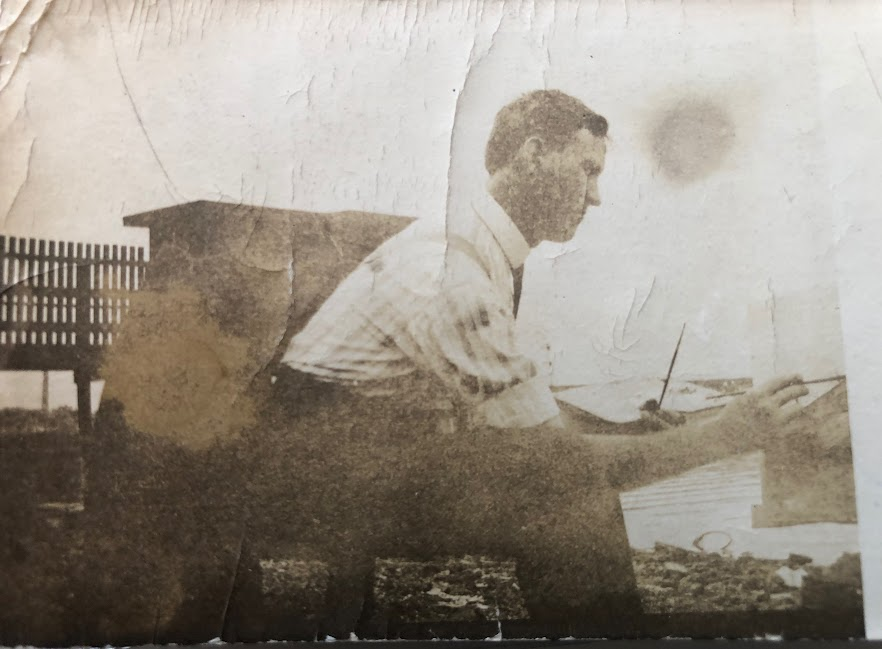
Elmer L Ham painting a seascape on location (en plein air) location unknown

Discovering this photo of Ham painting on location confirmed what I had expected when I first saw one of his paintings.


There is something about painting on location which I find intoxicating.  As I've written elsewhere, I came across a few old beaten up black portfolios thick with paintings tucked away in a corner in an upper floor amongst overturned furniture.  When I opened the first portfolio I was mesmerized by the painting after painting, which had the life, movement, and crispness of having been painted on location or at least having been painted by someone who was a student of both nature and painting.

Here are examples of a couple of watercolor field studies done on location by Ham.  Ham often traveled and painted on location with his life long friend - Vladmir Pavlovsky (1884-1944).  Ham and Pavlovsky shared a studio in Boston on Newbury Street.


Watercolor Seascape by Elmer L Ham


Watercolor Seascape by Elmer L Ham


Lessons Learned - Is your painting complete or it it finished?

Ammonnoosuc River - Watercolor on Paper

I did some detail work on my large watercolor of the Ammonnoosuc River in Northwestern New Hampshire.  On the lower left, was the early pass at the subject.  I will, from time to time, revisit a subject.  As I had left the picture, it struck me as close to what I was trying to achieve, but overall too dark.  It was accurate feel for the day and time, but the river didn't match the sky.  I decided to just leave things as they were for the time being to get some distance.  Often in Nature - there are times and locations that are quite interesting and moving, but they don't necessarily translate into a strong composition or painting without some artistic license.

There were parts of the picture that seemed flat to me, not enough of a difference in value.  I wanted to increase the interest throughout the picture while not confusing the eye with too much detail.  I remember vividly my first art show many years ago.  I was not really ready to show - but I went for it anyway.  

I walked the grounds and viewed the works of other artists and I found myself to be exhausted by the end as I was focusing on every detail I could.  I didn't really understand the lessons I was learning at the time.  The eye is naturally drawn to detail.  How to balance detail with leaving much up to the viewers imagination?

Years later I went to an exhibition of NC Wyeth, Howard Pyle, and Andrew Wyeth at the Farnsworth in Rockland, Maine.  It was a breathtaking exhibition and really a master class on both composition and using, or avoiding, detail to draw the viewers eye to the intended center of interest.  What I noticed immediately was that these paintings were at once very dramatic and moving, yet very "relaxing" to view.  I wasn't searching the center of interest - it was clear in each and every painting.  It wasn't really until the second or third pass through the exhibition that I began to notice the areas of a painting that were merely indicated with a minimum of brushstrokes and subdued values.

    
I brightened the sky to bring it into line with the river in the mid ground and darkened the water in the shadows in the foreground. and I also did some more variances in value throughout all the areas of the picture to add depth and interest.

            
       Detail Left                                       Detail Center                                      Detail Right

I also added some shadows to the rocks in the foreground and added more variance in the values on the small island.  It is a challenge to know when enough is enough with any subject.  Sometimes one brushstroke can be just what a painting needs to bring it to life, or it can ruin a subject.  As Bob Harris (Robert George Harris (1911-2007) Artist and Illustrator) advised me: 

"It's important to know when a painting is done before it is finished!"

None of this is meant in any way to detract from interest or pursuit of highly detailed paintings or Trompe l'oeil paintings.  Those types of paintings are simply not an area of interest for me - at this time.  I do believe that every type of painting, every attempt, informs my work on my next painting.  If you can express what you want to - what moves you, I don't believe that there is a "wrong" way to approach that painting.  


Above the Old Mill Pond Study

Watercolor Sketch - Above the Old Mill Pond

As of late, I've become more and more interested in cropping compositions differently, almost approaching the abstract.   This quick watercolor sketch is based on reality, but not exact.

I'd gone out on a Sunday morning sketch trip and revisited on old mill I'd sketched before in pen and ink.  I sketched the building from the side of the road from a much lower perspective.  The old dam, in the lower right of the composition, was also another subject of interest for me.   The mill pond was was also a point of interest that could not be seen from my original vantage point.

These sketches also took place in the winter.  I decided to imagine what the scene would look like in the fall with the reflections of trees and then how I could alter the perspective and still be true to the mill and the old dam.  So what started as a subject focused on the mill in winter, turned out very differently.  

I enjoy the process of when I am working on a painting or even when writing, that I have a clear idea of where I want to go, but the painting develops a will of its own.  This was a quick watercolor sketch that I will definitely expand into a larger more finished work.

There was an older mill across the street that I'd hoped to paint and sketch, as there were many interesting angles and designs in the decaying mill, but the last time I went back to sketch, the mill had been torn down.

watercolor sketching

I recently started experimenting with compositional sketches in watercolor.  Watercolor allows me to quickly block in a scene, experiment with color and different ideas for the subject.

The corner farm at dusk was just a quick impression I caught a glimpse of while driving home from work.   These sketches were only done in watercolor.


The second sketch of the corner farm is what it might look like as a winter scene with cornstalks as were actually there.  I changed the sky and moved the trees behind the house and moved the house further back in the composition.  I also extended the heighth of the silo.


From these quick small sketches I will continue to refine the paintings with more detailed studies (such as the corn stalks) before launching in to a finished painting.

All of these materials, a portable watercolor palette, a small water container and the watercolor paper scraps fit into a small sketch bag.  It's a quick ready to go at a moments notice.  I've put a couple of small watercolor brushes in a baggy along with pencil and charcoal should I desire to sketch in different media as well. 

Keeping these sketches "sketchy" will allow me to retain the enthusiasm necessary to continue to create and add throughout the process to the finished painting.

Ammonoosuc River #2


Ammononusuc River #2
Watercolor on Paper 
15" x 22"

This is a painting of the Ammonoosuc River in New Hampshire that I completed yesterday (in my basement - totally observing social distancing).  I will do some more studies from this to capture the water in different moods / speeds et cetera.  It's amazing how much the same "scene" can vary based on water and light reflection.

Below are studies used to work out aspects of this "final" painting and the final painting itself to give you some sense of scale.  Missing are a large (rough) pencil sketch with notes that I completed on location as well as a few pen and ink composition studies.

The top left and right watercolors were completed on location during the same trip as the pencil sketch.  The upper middle watercolor was done at home a few days ago (nearly a year later than the on location studies).    (see link below)
 Permalink
https://robertkahlerlandscapepaintings.blogspot.com/2019/05/mt-washington-and-amonoosuc-river.html


Now if, like me, you had been told that in order to execute a painting you would need to do upwards of six preparatory works (in this case a pencil sketch, 3 pen and ink composition studies, two on location watercolor paintings, and another color study) my enthusiasm for painting would have taken a nose dive.  I would have just wanted to get started.  I still prefer on location paintings started and completed in one go.

However, over time, I've worked out a method that works for me.  On location studies are what ignites my enthusiasm for painting.  The time spent on location, usually within nature, is time I cherish and that I find to be renewing.  I've written before about how amazing it is to me, that an on location painting can literally bring me back to that day even more than 20 years later.  Those paintings serve as a touchstone for memory and inspiration.

Generally I'll complete two or three on location studies per trip, generally the most detailed first, with each following painting becoming looser in its execution.  This lessening of detail occurs most likely for two reasons.  One - there is always a time pressure as light and attention both fade over time.  Two, simplifying a composition in nature is almost always necessary in order to emphasize the center of interest in the subject.

Stormy Day in the Basin


Stormy Day at the Basin
Watercolor on Paper 
18" x 22"

I do find that there is a beauty in every mood of nature.  The movement of mists and fog rolling in, rising from lakes and ponds, and  spilling down mountains is fascinating to me.  Objects partially revealed, never fully, and then they are gone.  This subject was based on an on location painting I completed in Grafton Notch more than 20 years ago.  Still a little more work to do on this but I enjoyed tackling a larger watercolor - it had been awhile.

Below is the painting this subject was based on.  During the course of painting this I had to retreat to my father in law's truck.  I can still hear the rain on the roof when I look at this painting.     


This painting was one of the first times I was able to capture the mood of a place at a specific time.  It's a little rough and unfinished, but still remains one of my favorites.  I emphasized the sky more in the recent watercolor, lowering the mountain height and adding a small tree covered island to help with scale.

I also added the trees to the right as there was a peninsula there that I did not include in the study above.  You can see indications of trees that I'd begun on the right but then I switched my focus to the atmospheric effects and left the peninsula out.


Sunset, St. George River

Sunset, St. George River
Watercolor on Paper
9" x 12"

This was the scene (varied slightly) at the rear (or front depending on your perspectice) of the Olsen cemetery looking out at the St. George river.  Sometimes I need to be clubbed over the head before I decide on a final composition.

This pen and ink composition sketch (4" x 5") had the island as was, smack in the middle of the view - preventing the eye from going into the picture.    Then I did a quick watercolor sketch (not pictured) from memory and this small sketch - moving the island to the viewers right.  Two things stood out to me - one the move to the right helped but not how I'd intended.  I really wanted to emphasize the light in the whole in the tree and this composition failed to do that.   I then noticed that I'd put the island smack dab in the middle of the watercolor (if not the view between the trees).  

Still that "failed" watercolor brought me back to the moment that had impressed me weeks before.  I altered the orientation of the paper and produced this watercolor this morning.

Sunset St. George River  WC  9" x 12"

Winter 4-6

Winter Paintings 4 - 6

These three paintings were not completed on location, but resulted directly from on location observations.  In each case, I went home after visiting a location and completed these drawings and paintings from memory.

Fort Williams and Moonlight, Ice, Androscoggin were competed very rapidly in one setting.  I didn't have my paints with me  at the time, but I wanted to capture my enthusiasm and the excitement of the moments as soon as possible. The bulk of the larger oil was completed in one sitting as well.

I enjoy working through the design process as well, but when producing a finished painting, I like to keep things as spontaneous as possible.  Painting on location helps me to "keep things fresh."


Charcoal on Paper - Fort Williams Winter
8" x 11"


Moonlight Ice Androscoggin
Watercolor 8"x12"
(First Prize, Watercolor 10th annual Joy of Art)


After the Storm - Oil Painting
24" x 36"

Winter Landscapes 1-3

I have a complicated relationship with winter. The older I get , the less I enjoy winter (shoveling and driving really).  Yet there is an undeniable beauty in winter with all its moods.  The morning shadows and the reflection of sunsets in the snow will steal your breath as sure as the frigid air will.

There is a crispness and clarity to the landscape unlike any other season.  The patterns of shadows on the snow and reflections on brooks and rivers   And the blue moonlight nights are truly magical.  I thought I'd completed a handful of winter scenes over the years but in going through my paintings recently to get ready for an exhibition, I found that I'd completed more than a dozen which I will post over the next few weeks while waiting for more fresh snow to paint.

Nor Easter Maine Coast
Charcoal on Tissue Paper

After the Ice Storm, Lisbon ME
Acrylic on Canvas

Watercolor - on location
Ammonoosic River

The Sluice - composition deconstructed


"The Sluice"
Paper Mill Trail
Watercolor on Paper

This painting is an example of how I've taken different elements from an area to create a composition that isn't exactly what exists in nature, but which still honors the landscape and captures the feeling of the landscape that does exist.  My interpretation of the landscape, so to speak.

The basis of this painting was captured with an on location watercolor sketch (which looks little like this final composition)..  The tree covered hill to the left, the "pond" the sluice (right mid-ground) and the rapids are as was.

The stones in the foreground, do exist but would actually be out of sight to the left and below the edge of the field, forming the wall of one of the canals and a foundation for part of the mill..
The background of the picture, is actually an expanded view from upriver.  The actual view from this spot, wouldn't allow the viewer to go back into the picture.

Hopefully, this scene will feel familiar to those who are familiar with this Mill Street view in Lisbon.  But furthermore, hopefully this scene will touch the memories of those who have grown up near old industrial sites being reclaimed by nature.  If I've really done my job well, this picture will also appeal to people on its merits as a painting.


Lisbon Mill Ruins - reconsidered


Mill Ruins - Lisbon Maine (The sluice)

Old Mills were so common while I was growing up in Westbrook, Maine.  Some have found new life and are being redeveloped and re-purposed.   The same thing is happening in nearby Lewiston.

Since moving to Lisbon Falls in 2003 - three mills in town have been demolished.  These ruins have further been demolished as part of an effort to rehabilitate the river.  I'd started to sketch another mill in nearby Sabattus - and a month later - that was gone too.

This large watercolor was started about a year ago and, as is often the case, was set aside while I worked on other projects.  I then darkened the sky with another rich wash of blue (see the picture on the left below) but that didn't really seem to balance the great deal of activity in the foreground of the painting.   I added some clouds as was (same picture) and lightened the sky.  Back to the revisit bin for a few more months until earlier this week.


I decided to be much more aggressive reworking the sky, to add more dynamic clouds/ patterns and I was happy with how this turned out.  Still a little more work to do, but almost there.

I'll explain the construction of this composition in another post.


Pemaquid in Progress


Composition Sketch in progress- Pemaquid 

This compositional sketch is the result of the roughs below and two on location watercolor studies.  It is intentionally not detailed.  I enjoy the design process.  I never used to take the time to experiment with different compositions - I just wanted to dive into painting (Truth be told, I still struggle with that).  But I consistently started running into composition issues which were so labor intensive to correct.  

In this case, I'll also re-position the boat further back and alter the angle of its profile so it leads back into the cemetery.  These are small rapidly executed studies, including the watercolor on index card below.   There will be much more foliage, as was in reality, in the final paintings.  Shadows in the foreground were also part of this composition.  I will also try a winter scene with shadows as an important part of the composition. 


Watercolor Study on Index Card 4" x 6"

One of the effects along the coast and tidal rivers that I find particularly interesting are the vignettes of color of the ocean between trees.  I'm also working to study more of the dramatic skies that we have here in Maine.  The skies effects are so fleeting - yet beautiful and dramatic.  I also enjoy working in Monochrome - to focus initially on value and composition without having to give a thought toward color is freeing.  Working on the different color variations is an entirely different - yet no less exciting process. 

Stay tuned.


Sunset Runaround Pond

Sunset Runaround Pond
Watercolor Study

I was reviewing sketches from an old sketchbook today and settled on pencil sketch I'd completed on location years ago along with a few color notes scrawled in the margins of the sketch.

This watercolor study was inspired by my memories of a brilliant sunset and reflections on Runaround Pond in Durham, Maine.  I had just pulled in and explored briefly before being struck by the contrast of deep orange of the sunset juxtaposed with the dark greens of blues of the pine and spruce and then lightened again by the reflections in the foreground.  These effects are so very beautiful to witness and so fleeting.

For some reason, I had the place to myself that day and enjoyed the stillness and quiet as night fell.  This overall effect likely lasted less than 15 minutes but has never left my mind.

Peavey's Pasture Eastport ME

Plein Air Watercolor - Peavey's Pasture Eastport Maine

Had a wonderful time in Eastport Maine with family last weekend.  We had beautiful sunny summer days as well as a day of rain showers , clouds, and sea smoke.  So many moods and a painting everywhere you look (Of course I have that problem of seeing paintings everywhere I look all the time - even when driving).

This rolling pasture down to the sea was very striking and had so many different points of interest.

I had decided in advance to bring only watercolor on this trip and completed three paintings on location, observed constantly and took notes for many additional subjects.  Of course, as soon as I saw the harbor and the complex myriad of boats of different shapes and colors with a lot of white, I'd wished Id brought my other mediums as it was too complex for me to attempt that subject in watercolor.  Ahh well.  I suppose I could have done it as a monochrome painting with detailed color notes for later.

Elmer Ham floral


Elmer L Ham - Pastel Floral

Here is another fragment of a floral study by Elmer L Ham.  I've really enjoyed working through these fragments and experimenting with different compositions.  
I've never really tried collage before but I think I will in the future.  I'm now keeping scraps and bits that I used to throw away for further consideration down the road.   Sometimes preliminary pieces are so much more freeing to work on - that happy accidents can occur.  

While working on some of these fragments its been very interesting to see the different perspectives approaching abstraction. 

The above fragment is a Pastel.   Below is a watercolor fragment.


I'll include more floral still lives in other posts.  This subject matter definitely reflects Ham's training with Laura Coombs Hills.


abstract seascape study


Here is another full sheet watercolor study by Elmer L. Ham.   The pictures don't do it justice.  It has an almost abstract quality about it.  It strikes me as another on location study.  Faint pencil lines block in both the major masses of rocks (Feels more like California than Maine to me) as well as of the wave action - see below.


The sense of movement is captured and the white of the paper also is utilized effectively to capture whitecaps as well as foam from waves crashing on rocks.  It all implies to me a familiarity with the ocean as well as this particular location.  That is only reinforced by the deft strokes of a loaded brush throughout the painting.  

This strikes me as a rapidly executed sketch (you have a max of a couple of hours before the light changes too much - and my reality of painting along the coast is that you tend to have a shorter window).  But everything is contained within this first pass to allow the artist to go back at any time to finish the painting or to use this as a basis for a finished painting.

I will show more of his completed seascapes in future posts but I enjoy sharing some of my interpretations of the artists thinking.  They are not complete but , for me, the sense of movement is there and I can hear the surf (it could be the tinnitus but I prefer to think it is the surf)

Elmer Ham Fishing Boats


Sketch of Fishing Boats - Watercolor by Elmer L. Ham
8.5" x 10" Sight Size
11" x 14" Framed

There is a quality about a sketch that I particularly enjoy.  You get to see the artists thinking and focus as they work.  What the artist finishes and what the artist leaves out is often telling. 

To me, this study is one of light, shadow, and reflection.  Note how the shading on the boats add depth and form.   On the near boat, how the shadow and rust on the way below deck add form and substance.  The shadows on the second boat on the fishing nets the shadows from the fishing nets on the small boat in between the larger boats.

Also, note the reflections in the foreground, they are not static.  They are fluid and evoke the feeling of moving water. This is the result of years of observation.  Whether or not this was done on location, I have no proof, but it is too close to the subject to have been done as an exercise or from a photograph.

The pencil lines for rigging again are not perfectly taut but as one would find on a working boat in harbor.  The lines for the wharf also frame the composition nicely.  If the wharf were added, it might well distract from the ships.  This may have well been why the sketch was not completed - but there could also be a hundred other reasons.  I do know, from the paintings I have in my possession, that Ham would often return to a subject to emphasize a different aspect of the painting or to tighten up the composition.  Another plausible explanation of why this subject was not completed could have been that it had simply served its purpose for Ham and he kept it for further reference.

I decided to mat and frame this sketch.  I'll replace the white mat with a colored mat to bring out more of the colors within the boats to tie everything together.


Sketch of Fishing Boats - Watercolor by Elmer L. Ham
8.5" x 10" Sight Size
11" x 14" Framed

Yellow House


Here is another light filled watercolor landscape painting from the portfolios of Elmer L Ham that I discovered in New Hampshire.  Ham spent much of his long life along the Maine, New Hampshire, and Massachsuetts Seacoast (Portsmouth, Boston, Newburyport, Eliot, and Kittery Point to name a few).  This includes nearly a decade that Ham spent in Los Angeles California.

Although the ocean (or river) is not a large part of this subject, it is important to the composition and color pallette of this painting.  It creates more of sense of light and brings the yellow maple into focus as well.  This is a quintessential New England Scene.

The effects captured in this painting, of light and shadow, of the atmospheric effects of the clouds and sky lend further credence to my belief that Ham spent much of his time observing and painting on location prior to executing these full sheet watercolors.

Another thing that attracts me to these paintings is their sense of spontaneity.  The effects are broad and loose, yet precise and accurate at the same time.  It's a difficult balance to achieve, yet Ham has been able to accomplish that in painting after painting.

Whether these paintings were done for enjoyment, exhibition, or sales in general, I have no evidence.  But a number of the far better known Boston School Painters, including Ham's teacher - Laura Coombs Hills - executed similarly freely painted watercolors which were quite different from their more well known subjects.  Artists such as Aiden Lassell Ripley, John LaValle, and Frank Benson executed impressionistic watercolors throughout their long careers while painting formal portraits, commissions, and still lives as well.

Crashing Surf and Boats in Harbor


Here is another watercolor painting in the portfolio's that I purchased by Elmer L. Ham. The sense of movement and color that he has captured here speaks to me of someone who spent a great deal of time painting on location and observing nature.  I have no evidence to prove that, only conjecture, a lifetime of observing the ocean and twenty plus years painting on location.

This painting is also freely and confidently painted.  The brushstrokes are visible and help define both form and movement without being overworked.

Today, Ham seems largely forgotten.   A quick review of sales records indicate that he seems to be most well known for his pastel still life drawings of flowers which reflect his training by noted Boston and Newburyport artist Laura Coombs Hills.  The watercolor above and paintings I'll share later show his talent and his interest in his surroundings. 

Here is the beginning of what I've been able to find out about Elmer L. Ham.

Early Years :  Portsmouth and Boston


Elmer L Ham was born in Portsmouth New Hampshire on June 18, 1884 to Robert and Sarah Ham.  He had an adventurous spirit as reflected in a September 15, 1897 article in the Portsmouth Herald.  This article recounts his unauthorized journey walking from Portsmouth NH, sleeping in a barn, and then eventually being discovered by the police “wandering around Market Square (Newburyport) late at night.”   Ham was 13 years old at the time of his first trip.  Elmer attended Portsmouth schools and by 1903 (age 19) he was working as a printer’s apprentice in his father’s print shop in Portsmouth New Hampshire.   (1903 City Directory of Portsmouth NH)

By his mid 20’s, Ham had relocated to Boston and was working in a sign painting shop.  According to the 1910 Federal Census Elmer was an Artist / Librarian for a sign painting and catalogue company.  A number of landscape paintings in watercolor and pastel reflect areas nearby his Allston apartment including the nearby Charles River, Harbor, and Boston Public Gardens.  Other identified paintings include the locales of Newton and New Bedford.  Boston City Directories have Ham listed as continuing to work as a commercial artist for sign companies throughout the late 1920’s.


Fishing Boats in Harbor
15" x 21"


Fishing Boats in Harbor - Winter  15.5" by 22"


These two paintings also speak to me of on location observation.  They are not your typical subjects, particularly the winter subject.  These are also both on large/ full sheets of watercolor paper.  Notice the white of the paper is used for effect in both of these sketches.