Showing posts with label #moonlight. Show all posts

Is it Done or Is it Finished?


These two photos of two of my most recent paintings give a better sense of the size of the water color sketches to the finished work.   For these two acrylics, the sketches are about 1/4 the size of the finished work.

With the large watercolor I did  of the Amonoosuc River, the ratio was more like 7 1/2 to 1.  At this point, I don't do a detailed scale down or up from sketch to finished painting, it is more just a part of the process.  Trying to keep this as simple as possible for quick and efficient sketching in an attempt to capture the moments which catch my attention.

I'm quite motivated by the idea of capturing the different moods of a subject, and even imagining them based on earlier observations of nature.  Both of these paintings are realistic subjects - they do exist, but in imaginary perspective for the old mill pond, and imaging a winters evening full moon light at a local farm.   I really enjoyed these different exercises in the studio.  Working on location remains my first joy in painting, but studio work is gaining in its standing and enjoyment for me.  

I also try to keep the advice of two well known and highly successful artists front and center as I paint.  John Stobart advised putting only as much detail into a sketch as would be needed to execute a finished painting later.  This was to avoid "copying" even one's own work and maintaining room for the spark of creativity.

The late Bob Harris (Robert George Harris) was very encouraging to me through our correspondence and phone calls.  One of my favorite quotes of his is:  "It's important to know when a painting is done before it is finished."  

I also remember vividly the original illustrations by N.C. Wyeth and Howard Pyle on display at the Farnsworth Museum in Rockland, Maine.  The paintings were monumental in scale, composition, color, and use of limited detail.  They knew how to lead your eye where they wanted it to go.  A large area of background scumbled in with virtually no detail in no way diminished these paintings.  On the contrary, the contrast made the paintings even more powerful.  You really had to be on the lookout to even notice these techniques.


Early Spring Evening

Early Spring Evening
Acrylic on Canvas Board
12" x 16"

This is the first studio evening painting I've attempted.  I enjoyed the challenge of muting the colors down, while still capturing the sense of atmosphere on a moonlight night reflecting off the silo, house , and late spring snow.

The inspiration for this painting is a farm I pass by daily on my way to work.  The elements of this painting are all there, just not in the location that I've included them.  I've included a couple of water color sketches below which were the beginnings of working out ideas for this painting.


The watercolor sketch on the left was impression one of a scene toward dusk.  The sketch on the right was a second iteration, which moved the trees behind the house to add emphasis to the house.  I was also experimenting with corn in various stages of decay in the foreground.  

Just quickly looking at these sketches, I can easily see 4 to six different paintings, including a night scene with the snow - which is what I decided to paint.  Below is the first block in, where I was trying to accomplish two things.  One, not to waste paint from another painting I'd just finished (The Yankee in me) and to cover the canvas to make it more workable.  Two I wanted to rough in the composition.


I didn't attempt to block in the tones of evening in the sky, in part, because my one attempt at painting at night (so far) proved to be too dark when examined in the light of day.  I find it's easier to go darker than to lighten up a painting.  I did intentionally block in the dull colors as the base for the hay/ field in the finished painting.

I added the building outline in making one significant change  I moved the house in toward the center and changed the direction of the house to lead the eye into the picture.  I first sketched it in in charcoal as I did in the watercolor sketches - but it instantly struck me as wrong and I changed it to the final composition.  I didn't bother to sketch in any more details as I had the sketches and the impressions from observation to go from and I enjoy continuing to compose as I paint. #pushingpaintaround

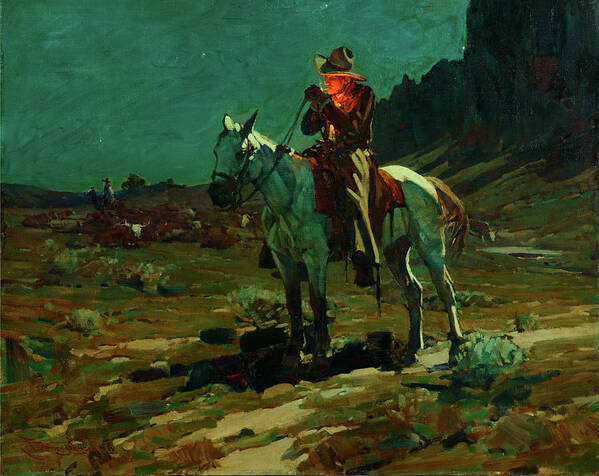
One painter whose evening painting (nocturnes) I admire is Frank Tenny Johnson.  His western nocturne's take my breath away.

Night Time in Wyoming Poster by Frank Tenney Johnson


Moonlight on Mountain Pond

I spent a few hours in the studio the past couple of evenings matting drawings and paintings to see what I'd like to enter in my next juried exhibition.  Sometimes framing or even simply matting a painting or drawing help expose any compositional flaws.


Moonlight on Mountain Pond

There is a stillness in the wood
That is hard to comprehend
As I hike away from civilization, from the “should’s”
I leave the car and my worries behind

The daylight views are dramatic enough
But the night sky and the dance of moonlight and shadow
On clouds, mountain, forest and stream
Leave me spellbound

Like the sirens of myth
It is possible to become lost in natures song  
But the sound of my heart provides the rhythm
To the silence
Provides the anchor in the storm
The storm we all carry inside

In a few days
I’ll be back at work
Surrounded by activity and sound
The “should’s” will have returned in full force

In moments of decision,
I strive to remember
The mountains
The dance of moonlight and shadow
The silence

I am learning to be still