Showing posts with label #LandscapePainting. Show all posts

Process versus Spontaneity


Acrylic 12" x 16"

This is an update on the progress of Beaver Pond - Crawford.   This represents about 45 minutes of work with Acrylic directly on canvas to block in the composition and then about 10 minutes on another day to begin to zero in on correcting colors.  (2nd pass)

My favorite type of painting remains on location painting, starting and finishing in one session - generally about two to two and a half hours.  However,  when I don't have the time to paint on location I'll use on location sketches and trips as inspiration.  I've documented this elsewhere if you are interested.

In general my method in these types of cases for acrylics is

Compositional Sketches (very loose - mostly line drawings)
Larger Charcoal Sketch to work on values

Then onto working with Paint:

1st Pass  Covering the Canvas in Paint
                    Blocking in the composition rapidly
                    While attempting to get colors and values correct at this stage - but 
                     not worrying if the colors are off 

2nd Pass  Fine tuning painting for both color and composition

Set aside for a few days (or months or years in some cases)

3rd Pass (if painting is not completed) further refinement


I resisted developing a system or process for years.  I just wanted to get out and paint.  While that helped me develop as an artist in many ways, it was also frustrating for me as I often spent as much time searching for what I needed, often wasting what little time I had for painting.  

I've slowly come to realize that even on a day when nothing goes as planned with a painting, if the results are horrible and in no way reflect what I am trying to capture - it's fine.  I still have learned something.  

It took me years to establish a system that works for me with the time I have that still allows me to maintain a sense of spontaneity and excitement when I'm painting.

I also have a "go bag" (three actually) for Watercolor, Acrylic, and Charcoal in addition to my main paintbox which I will switch out between all of the above and oil paintings.


Fall Reflections by Elmer Ham


Watercolor by Elmer L Ham

I love the light and the sense of atmosphere captured by Ham in this watercolor painting.  While this is likely a painting executed in studio - it clearly demonstrates to me the lifetime Ham spent studying nature and painting and sketching on location.

This is most likely a Maine or Massachusetts scene by Ham.  I've seen landscapes and florals executed by Ham in Watercolor, Pastel, Oil, and Pencil.  

Working as a sign painter and painting outdoor advertising murals allowed Ham to pursue his love of painting throughout his life.  Ham exhibited paintings in Boston, Provincetown, and Springfield Mass, and Ogunquit and York Maine as well as in competitions and local venues throughout New England and California.


Beaver Pond - Crawford - in progress


Beaver Pond - Crawford
Charcoal - 18" x 24"

The above charcoal is part of my process in what will be one of my next paintings.  I stopped on my way home from a trip Down East at a little roadside rest area in Crawford.  The play of light through the thick trees and the reflections in the beaver pond on the far side of the brook running through the rest area.

There were so many potential subjects to paint.  In years past it would have been overwhelming. But I've learned to just take a deep breath and to simply soak in the sights, sounds, and smells.  I had the place all to myself for nearly twenty minutes.  I took a few photos for reference as well as I didn't really have the time to sketch as much as I would have liked.  For me, photo's have become a way to take notes at times when there is a fleeting effect in nature, or as in this case, an area that is not one I'm likely to get back to very often.

I suspect I'll never see this place looking the same way again.  The water was so low due to drought so what was normally out of sight in the middle of the river was front and center.  Judging by the river bank, I was standing high and dry in what was normally chest deep water.  

Below is a page from my sketchbook.  I made the two compositional sketches on the left with a few notes from my recollections.  I wanted to paint some compositional sketches but I simply didn't have the time to paint even small sketches.


The first few compositional sketches were closer to as the scene really was, but in order to capture the feelings I had while there, I needed to rearrange the elements and open up the composition as in the larger charcoal sketch.  I've grown to really enjoy working out compositional issues in these quick sketches.  It's almost like completing paintings except that it's much quicker and I haven't spent two hours painting something to then discover I've got to start over if I want the effect I was pursuing.

Am looking forward to launching into a large watercolor of this subject and smaller oil.  I am also thinking of painting this view as a fall and winter subject as well.

New England Fall


New England Fall
Acrylic 24" x 36"

I did some touch up work on this painting yesterday.  The bulk of this painting was done long ago, but I had never been happy with the sky.  So I took the painting as far as I could and left it for later consideration.  Sometimes days, months, and in this case years pass before the solution comes to mind.

I've been working on a series of paintings and paying more and more attention to the role of skies in a composition.  I am becoming much more confident and therefore looser with my skies.  The effects of skies are so fleeting and complex that it allows one to paint almost to the point of abstraction in an otherwise realistic style.

One of my artistic inspirations, John Stobart, as well as other experienced Plein Air painters will often wait until the sky strikes them of interest and then they paint it in and adjust the more permanent areas of the painting (shadows etc).  This scene is an imaginary setting based on my own exploration of the Maine landscape.

This painting is one of five that I've entered for consideration at an upcoming juried show.


Riverbed Reflection

Riverbed Reflection
Acrylic 12" x 16"


This painting is a challenge that had been bouncing around in my head for more than 25 years.  Water is always a challenge to capture, even when it is still.  The slightest wind, the time of year, the color of the material of the river bed.  Nearly endless combinations are possible.

Julie and I were exploring the area around tumbledown mountain and there was a beautiful scene of a riverbed surrounded by fall foliage.  The riverbed was all but empty this late into the fall.  I came across these scene with a reflection of the sky and trees on three sides.   

I've a number of  ideas and sketches for a series of reflection paintings.  This subject was about as abstract as I tend to get with my paintings - I did really enjoy the challenge of working with only three colors plus white.  

Alternate versions of this painting could include different patters of reflections, additional puddles  as well as including fallen leaves for more color.

I actually started this painting in part because I am a yankee and hate to waste any paint.  I was taking a break from two other paintings and I had a mishmash of paint left on my palette.  I decided to use the paints to prime a new canvas board and as this idea had been bouncing around for while  so I just decided to  keep going.

Incoming Storm Sebego Lake, Maine

Incoming Storm - Sebego Lake
Acrylic 18"x 24"

This acrylic was painted on location at Harmon's Beach Sebego Lake, Maine many falls ago.  I can remember the day like it was yesterday.  I used a heavy french easel which I had to prop against a tree to keep it from being knocked over by the strong wind gusts.

It was so cold, that when I finished painting, I couldn't drop the paint brush, I needed to remove it from my right hand with my left.

I was focused on the water and sky, amazed at all the colors that we often think of a simply a grey day.  Like any painting I look at later, there are some things that I would do differently now, but i was and still am pleased with the effort.  I captured things that I could never have imagined because it was painted start to finish on location (en plein air).

When I look at this today, I am transported back to that moment in time.  I can hear the crashing windblown surf, and feel and hear the howl of the wind and the spray from the waves.

If you've never tried painting on location, I'd encourage you to do so.  Don't let people talk you out of it talking about all the challenges - its worth it.  I've found that even though some of the effects I'm trying to capture in nature are still beyond me, the mind takes in far more than you are aware of at the time.

For me, sometimes, things go exactly as I hope, or I have happy accidents, and I have a picture ready to frame.  At other times, I use the piece as a reference for a studio work, or I use bits and pieces of what I've painted in other painting compositions.  Others simply are stacked up in the studio. the result of many lessons learned - unlikely to ever see the light of day (or the internet).  Still it is time well spent, in my opinion.

#pleinair #pleinairpainting #acrylicpainting #landscapepainting #Sebagolake #Maine #arttherapy
#artforsale #paintingtips

FMI please visit robertkahler.com

The Sluice - composition deconstructed


"The Sluice"
Paper Mill Trail
Watercolor on Paper

This painting is an example of how I've taken different elements from an area to create a composition that isn't exactly what exists in nature, but which still honors the landscape and captures the feeling of the landscape that does exist.  My interpretation of the landscape, so to speak.

The basis of this painting was captured with an on location watercolor sketch (which looks little like this final composition)..  The tree covered hill to the left, the "pond" the sluice (right mid-ground) and the rapids are as was.

The stones in the foreground, do exist but would actually be out of sight to the left and below the edge of the field, forming the wall of one of the canals and a foundation for part of the mill..
The background of the picture, is actually an expanded view from upriver.  The actual view from this spot, wouldn't allow the viewer to go back into the picture.

Hopefully, this scene will feel familiar to those who are familiar with this Mill Street view in Lisbon.  But furthermore, hopefully this scene will touch the memories of those who have grown up near old industrial sites being reclaimed by nature.  If I've really done my job well, this picture will also appeal to people on its merits as a painting.


Lisbon Mill Ruins - reconsidered


Mill Ruins - Lisbon Maine (The sluice)

Old Mills were so common while I was growing up in Westbrook, Maine.  Some have found new life and are being redeveloped and re-purposed.   The same thing is happening in nearby Lewiston.

Since moving to Lisbon Falls in 2003 - three mills in town have been demolished.  These ruins have further been demolished as part of an effort to rehabilitate the river.  I'd started to sketch another mill in nearby Sabattus - and a month later - that was gone too.

This large watercolor was started about a year ago and, as is often the case, was set aside while I worked on other projects.  I then darkened the sky with another rich wash of blue (see the picture on the left below) but that didn't really seem to balance the great deal of activity in the foreground of the painting.   I added some clouds as was (same picture) and lightened the sky.  Back to the revisit bin for a few more months until earlier this week.


I decided to be much more aggressive reworking the sky, to add more dynamic clouds/ patterns and I was happy with how this turned out.  Still a little more work to do, but almost there.

I'll explain the construction of this composition in another post.


Crashing Surf and Boats in Harbor


Here is another watercolor painting in the portfolio's that I purchased by Elmer L. Ham. The sense of movement and color that he has captured here speaks to me of someone who spent a great deal of time painting on location and observing nature.  I have no evidence to prove that, only conjecture, a lifetime of observing the ocean and twenty plus years painting on location.

This painting is also freely and confidently painted.  The brushstrokes are visible and help define both form and movement without being overworked.

Today, Ham seems largely forgotten.   A quick review of sales records indicate that he seems to be most well known for his pastel still life drawings of flowers which reflect his training by noted Boston and Newburyport artist Laura Coombs Hills.  The watercolor above and paintings I'll share later show his talent and his interest in his surroundings. 

Here is the beginning of what I've been able to find out about Elmer L. Ham.

Early Years :  Portsmouth and Boston


Elmer L Ham was born in Portsmouth New Hampshire on June 18, 1884 to Robert and Sarah Ham.  He had an adventurous spirit as reflected in a September 15, 1897 article in the Portsmouth Herald.  This article recounts his unauthorized journey walking from Portsmouth NH, sleeping in a barn, and then eventually being discovered by the police “wandering around Market Square (Newburyport) late at night.”   Ham was 13 years old at the time of his first trip.  Elmer attended Portsmouth schools and by 1903 (age 19) he was working as a printer’s apprentice in his father’s print shop in Portsmouth New Hampshire.   (1903 City Directory of Portsmouth NH)

By his mid 20’s, Ham had relocated to Boston and was working in a sign painting shop.  According to the 1910 Federal Census Elmer was an Artist / Librarian for a sign painting and catalogue company.  A number of landscape paintings in watercolor and pastel reflect areas nearby his Allston apartment including the nearby Charles River, Harbor, and Boston Public Gardens.  Other identified paintings include the locales of Newton and New Bedford.  Boston City Directories have Ham listed as continuing to work as a commercial artist for sign companies throughout the late 1920’s.


Fishing Boats in Harbor
15" x 21"


Fishing Boats in Harbor - Winter  15.5" by 22"


These two paintings also speak to me of on location observation.  They are not your typical subjects, particularly the winter subject.  These are also both on large/ full sheets of watercolor paper.  Notice the white of the paper is used for effect in both of these sketches.

Fishing the rapids II


Fishing the Rapids 
Acrylic 18" x 24"

Sometimes an idea for a painting kicks around in my head for awhile.  Then it reaches a point where I have to get it out and onto canvas or paper and occasionally in the form of notes or poems.  More often than not I feel like a passenger on that ride rather than the pilot.

In this case, the version of the picture to the left was my first pass.  I've talked before about how I will often get a painting to a point of partial completion and simply set it aside for awhile.  There was always something about this painting that hadn't set quite right with me.  Despite the fact that family, friends, and even an impartial critic who selected the painting for a juried show liked the painting as it was.
Some of the differences between the two are do doubt because of different lighting.  While I made small additions and corrections throughout much of the picture - a small brush stroke and color adjustment here and there. the main adjustment was to the color of the large tree on the far bank (left bank) and the small trees in the left foreground.
Those color adjustments, adding primary complementary shades to the rocks and the muting of colors on the far bank really helped bring out the reflections of the sky in the water.  Other than covering my old signature and adding the new, I didn't even alter the water.  I was quite happy with how this turned out.  I was able to add contrast and some darker colors - while turning an area of the painting that had seemed flat and lifeless into one of interest that still supported the whole picture.

I'm now finding more pleasure in making small adjustments in color, shape, and form, to pictures that in the past I was quite content to just leave unfinished.  It's a different part of the creative process but one that I continue to grow in appreciation for daily.

The working process behind the original version of this painting can be found elsewhere in this blog.

https://robertkahlerlandscapepaintings.blogspot.com/2017/02/fishing-rapids.html


Now I can let it go and move onto something completely different.

Insipiration - Bath New Hampshire


Acrylic on Canvas Board 12"x16"

My earliest memories of covered bridges were on family trips to see my Aunt in North Conway, New Hampshire.  I was always fascinated by the construction of the bridges.  I can still hear and feel the car on the wooden planks of the bridge echoing throughout the bridge.  Being surrounded by darkness and large wooden beams was a stark contrast to the sunlight outside.  On stormy trips, the sounds changed from rain on the roof of the car to the muffled sound of rain of the roof of the bridge.  You can still see the foundations of the covered bridge on the way into North Conway on Route 302 - over the Saco River.  I have a vague recollection of the bridge being damaged by a fire.  There was some hope that it would be rebuilt, but that proved to be too steep a financial committment and the bridge was eventually demolished as the route into North Conway was redirected.

I've also been fascinated by the old industrial buildings alongside New England rivers.  I used to play in an old abandoned mill in my hometown.  It stirs my memory more today than it did at the time. The memories may not be fully accurate, but they are mine none the less.   The massive floor boards, frosty windows filled with imperfections of early glass  all combined with the heart pounding  excitement of being somewhere you weren't supposed to be, doing something you weren't supposed to be doing.  So many of these buildings were allowed to fall into disrepair as manufacturing jobs disappeared or moved on to other locations.  It's nice now to see that restaurants and other businesses have been rehabbing these buildings that were once the bedrock of so many communities throughout New England.

This painting is an example of what I've written about in the past.  It's a studio painting based on memories and emotions from my experiences.  The original idea for the painting came from some on location sketches from trips to Bath New Hampshire.  It is one of the largest covered bridges I've ever seen.  It's a beautiful village and a must see if you are travelling to New Hampshire.

Below are a few examples from my trusty sketchpad.  I started with some compositional ideas around the border of the page - pretty much from the upper left - clockwise around the page.  I then sectioned off the remaining center of the paper and once I'd sketched in this new perspective I knew that was the one I wanted to pursue.


Below is the first and second pass at the painting.  I started by toning the canvas with a warm earth tone and then preceeded to put in the sky and then blocked in the bones of the painting (the river bed, walls, and surrounding buildings.  The bridge was then put in next with no windows till the end.  This was a new type of canvas board for me.  It was prepped for watercolor - so I found that working in acrylics, these was very little tooth or bite to the canvas, so I had to adapt my style of paitning until I'd built up enough paint on the canvas.  Below I've shown the (Nearly) finished painting.


Fairly subtle, but important changes I think.  What are your thoughts?


One of my favorite artists, Aldro Hibbard, did at least one painting of this area from up above (to my right looking at the painting) and looking upriver.  It was breathtaking to see.

10 Annual Joy of Art Opening Reception

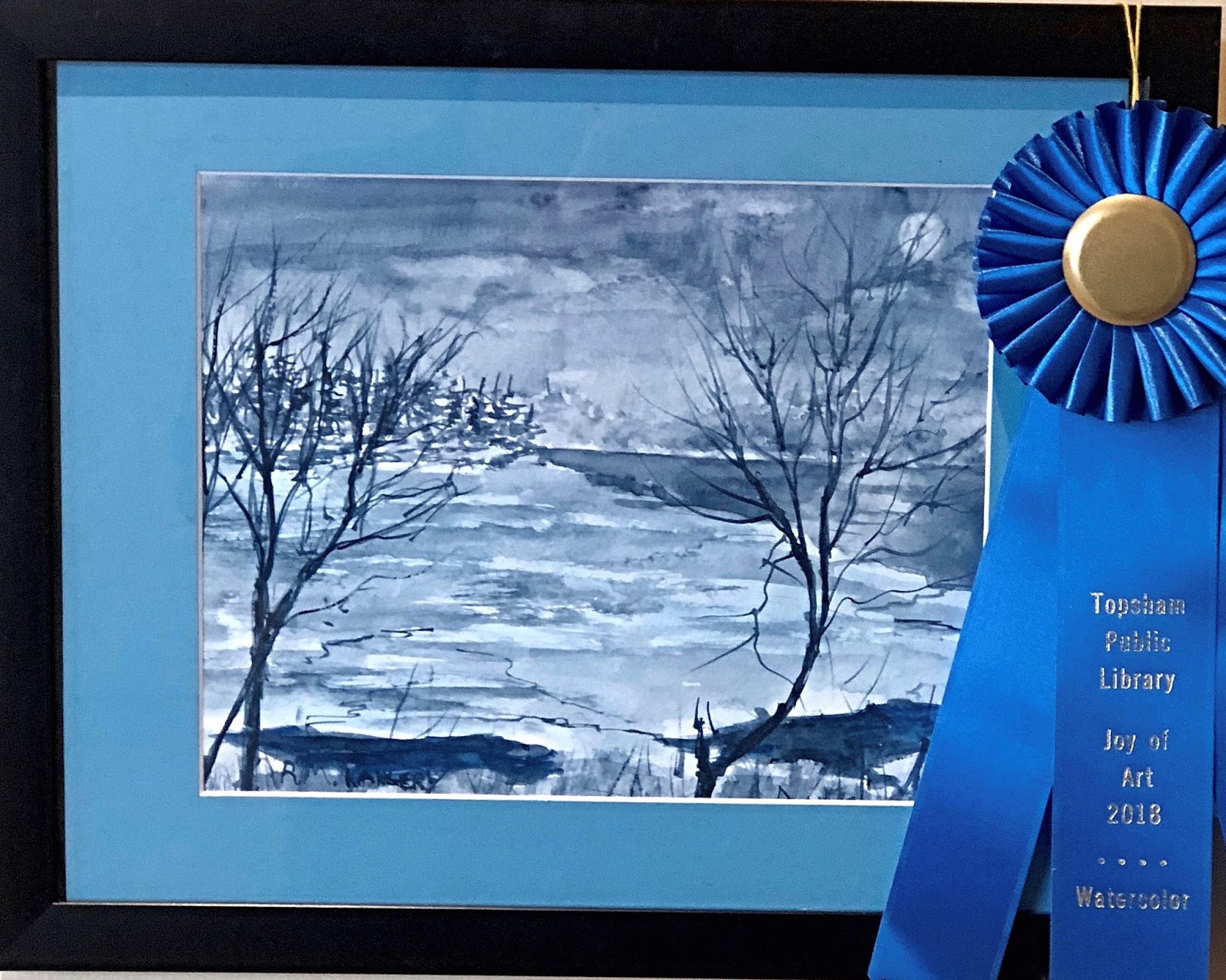
Julie and I aattended a woderful opening reception at the Crooker Gallery, Thopsham Public Library in Topsham Maine this afternoon.  It's always enjoyable to meet other artists and supporters of the arts and to see the many different expressions from different artists.  This Gallery and event is where I took my first steps to show my work outside the family (four years ago) and the staff was as warm, encouraging, and as welcoming as ever.

I entered two pieces in this juried exhibition.  A watercolor (Moonlight, Ice Out, Androscoggin) and an acrylic (Midcoast Marsh).

My watercolor, "Moonlight, Ice Out, Androscoggin" won first prize in the watercolor division.


I was speaking with another artist about her landscape painting, which I particularly admired, when a couple stopped by to listen to the conversation.  We spoke of the joys and challenges of painting on location and how it informs our work.  

The couple asked me what paintings I had entered in the show.   They then asked me to talk to them about my Midcoast Marsh painting.  I was able to describe to them the location which was the inspiration for the painting and about  my process for choosing and executing a subject.


"Would you consider parting with it?" and with that the painting was sold!  I'll write more about that soon.  It was so rewarding to hear the couple share their memories that my painting had stirred up of growing up in and around marshes and that Midcoast Marsh would have a home in thier cottage.

Thanks again to the Friends of the Topsham Public Library for this wonderful opportunity.


Georgetown Inlet


This watercolor sketch of an inlet in Georgetown, Maine serves a couple of purposes for me.

One, I'd been so focused on pen and ink drawings I missed painting.  In addition to composition and design, I truly enjoy working with  color and paint- watercolors in particular.  For whatever reason, I find it more enjoyable (and more efficient) to experiment with watercolor than the other mediums I work with (Acrylic, Oil, Goache, Charcoal, Pencil).  The medium of watercolor itself, I find it to be the quickest medium to get ideas to paper.   Some of that is simple physics - water flows quickly and smoothly.  Another reason is the ease of transport and clean up of watercolor.  I also began my artistic journey with watercolor so that is the medium I've worked with the longest.

One piece of advice I would give, is take whatever advice that is given to you for what it is worth for your journey - not as gospel.  One of the most common pieces of advice that I recieved is that watercolor is very difficult to work with.  That once you make a "mistake" you cannot correct it.  If we go into anything convinced that we cannot correct mistakes, that we must be "perfect" - we are unlikely to try in the first place or to persevere when we encounter the inevitiable challenges that go hand and hand with learning.

Don't get me wrong, classes or advice from those more experienced can be incredibly valuable and can save you a lot of learning time.  Just don't be afraid to forge your own path.

This studio sketch (living room actually) was an interpretation of a sketching trip Julie and I took to Georgetown Months ago.  I look forward for going


It was a grey day when I was sketching on location but for the purposes of the watercolor I wanted I experiment with different effects that sunlight would have.  This sketch has also given me some different compositional ideas.

What I've started doing now is storing sketches and paintings (when possible due to size) together for future reference.  For now, my pen and ink sketches are all still in the original sketchbook as I often find when sketching on location I'll find a subject for a quick margin sketch that fits with other subjects (such as one page of reflections) for potential future development.

The Georgetown area is so beautiful, I can not wait to go back.  And talk about having a magnificent "office!"  We are so lucky to live in Maine.

Georgetown and Tenants Harbor, Maine


Here are a few working sketches that I completed while picking up some of my paintings from the Plein Air Painters of Maine show at the Georgetown Library.  It is such a beautiful area.

The sketchpad I use is a simple 11" by 14" Acid Free medium weight paper. This first page represents some quick sketches I made sitting on a granite bench right alongside an inlet.  I generally make a few quick compositional sketches of scenes I am considering as well as local sights that could turn into additional paintings or elements that I might add into the composition later.  In other words real local buildings or natural scenes that you wouldn't see from this point of view but that anyone familiar with the area would be recognized.

This was a grey day and quite windy, but enjoyable.  Two ducks kept me company the entire time I sketched.  One black, one white.  Both very busy fishing.  I'm going to change the mostly hidden modern car port for a lobster shack that I remember (or imagine I remember) from Higgins Beach.

I plan to adjust the patterns of the lobster traps in the final painting as I've begun at the bottom of the page.


The sketch below is of a working wharf in Georgetown.  I happened to stop by as the days catch was being brought up to the wharf and then loaded onto the waiting truck.  I'm going to move the boat unloading to the near side of the wharf in the final picture.

To the right in the margin is a sketch of some fascinating reflections in a small building next to me on the location of the sketch above.  I could see reflections as well as into the building and out the other side.  It reminded me of something that Andrew Wyeth might paint ( no pressure there :)  


I recently purchased the book Wyeth and Kuhners.  It was filled with many of working sketches leading up to the final paintings.   It was very interesting to "see" his thought process behind some of his finished paintings.  The older I get and the longer I paint, the more my appreciation of his work grows.

Old Mill Stream


This large watercolor is based on a nearby mill brook in Lisbon Falls, Maine.  The wollen mill was torn down within the past decade.  I'd always said I'd paint it, but I waited too long.

The rock wall in the foreground is part of the old canal system and actually is not visible from this view.  The two rock walls in the mid ground are part of the canal/power system for the old mill.  On this day the water was low but running rapidly over a breach in the dam.

This is one of the few spring paintings I've done.  There are so many colors in the spring as the trees begin to flower.  Not quite fall like, but colorful none the less.  I've simplified the overall composition while trying to stay true to the acutal location.

This location is actually quite a gem.  There is a walking path on the left with a view of the brook which continues along the Androscoggin River.


Don't have everything you need to paint? - don't worry

Here is a sketch I completed today at a local stream.  I've also included a page from my sketchbook to further illustrate some ideas I'll pursue later in the studio.


This sketch represents the bones of what I'll work from later in the studio.  A number of things added some challenges (some avoidable, some not) to this day of sketching.  

My brush carrier had opened and most of my brushes had spilled out in the car.  Rather than go back I decided to forge ahead.  Another "mistake" I'd made was setting up directly in the sun - but this was the view I wanted to capture.  The paints dried very quickly in the pallette as well as on the paper.  Oh yes - I also did not bring my easal or paper towels.  So basically I brought myself and a partially stocked paint box :)  I hadn't restocked since my last outing.

Many year ago, any one of the above factors would have caused me to get frustrated and potentially not to have done any painting at all.  I've now painted enough that the act of painting this on location has developed, for me, a visual memory of the scene/location that will assit in final painting.

I remember a quote attributed to Picasso.  Someone had asked him what he would do if he were to run out of red paint (he was in the midst of a painting with a great deal of red I suppose.)  His answer -  "Then I'd use black"  In other words - he's express his idea with whatever material was at his disposal.  One of the things I strive for is to not let the medium get in the way of what I'm trying to express or capture if you will.

As soon as I completed the sketch I put down the watercolor block and my paints to dry before packing up. (This wouldn't take long in the sun).    I took the time to grab my sketch book, turn around and sketch a  couple of different views of the waterfall.  I will continue to develop these ideas into a finished painting or drawing at a later time.

The above picture is sketchbook page which illustrates the method I'e been using lately.  The middle of the page is blocked off for a standard size 8 X 10 drawing.  I then section off the border, which if I do decide to complete and frame the center image - the border skeches and notes would be covered by the mat.  The boarder sketches and notes are ideas for other paintings or notes on the location at the time of the painting. The sketches are tiny, but help me save time to work out design elements before starrting a finished piece.

These sketches are enlarged roughly 50%


New Hampshire Memories


This painting is an experiment with an old charcoal drawing that I completed after a trip to New Hampshire with my wife and daughter.  Both the trip and drawing were completed many years ago. 

Like many of my drawings, there were things I really liked about it and some things that didn't work the way I wanted them too. What I've learned over time, is that by observing a subject closely,  there is more that I retain / notice from the location than I'm able to capture at the time. So I simply put it aside and moved on to other subjects knowing at some point I'd return to the subject.

This painting is gouache on paper (over the charcoal drawing).  I'm really learning to enjoy gouache, though I must admit that transparent watercolor is still my favorite!

Reflections


"Reflections" - Oil 18"x 24"

I've always been humbled by nature.  In particular the oceans and as in this scene - the mountains.  It's always amazes me how quickly the noise and concerns of everyday life disappear when entering the woods and exploring along a river.

I have fond memories of camping with family and friends, but I have equally fond memories of the times spent exploring alone and recharging to the rhythms of nature.

I thought about including other figures in this scene, perhaps a canoe or a cabin in the distance. However, as the painting developed, the emotion and mood I was reaching for was that of a solitary figure.  In terms of scale, the figure is a small portion of the picture, but for me it was a corner piece of the puzzle.

Inspiration - better late than never.

I've had so many wonderful encounters on my artistic journey.  One of my first inspirations was my wife's grandfather - Ed LaSalle (nee Lassell).  I remember my first trip to Ed's house when I was dating Julie.  We walked into the living room and I was immediately struck by the paintings which were hung with care throughout the living room and music room.

The first painting I saw was a large fall scene of Tumbledown Mountain.  I can't find a photograph of that painting at the moment.

The painting below was hanging behind the living room couch.  This lighting isn't the best, but it was a large western (3' x 5')  Unfinished, but still very beautiful.  Ed was an illustrator in the 1930's - 1940's and painted landscapes on location well into his 80's.  More on that for another time.


I asked Julie about the paintings.  Never expecting to hear it so casually mentioned that her grandfather,and her grandmother were responsible for the art which filled the house.  The painting below was on the wall near the scene of Tumbledown.  This painting was by Ed's brother, Charles LaSalle (Lassell) - one of the country's leading illustrators in the 20's through the 50's.  


The family of artists also included Ed's cousin, Aiden Lassell Ripley, and Ed's son Aiden LaSalle.
I decided to do a research project on the family of artists as a Christmas Present for Julie and the people I met on that journey and the art they shared with me enriched my life more than I could ever imagine.  Subjects for other posts later.

Below is an example of a painting by Aiden Lassell Ripley.  Aiden was a national award winning artist who became the president of the Guild of  Boston Artists from 1959-1969.


Years after Ed passed away, I was able to purchase one of his paintings as a Christmas present for my wife.  Having that painting hanging at the foot of our bed truly inspired me to try painting.      

Stockbridge River Sketch


Stockbridge River – Acyrlic on Canvas 12” x 16”

I set up on a small bridge near tumbledown mountain years ago to complete this on location sketch in early spring years ago.  Some of my on location paintings are quite complete – others are very rough.  It depends on a number of factors from time, subject, weather conditions, and my reason for painting the particular subject.  If I’m experimenting with a new medium, new technique, et cetera, I’m not very concerned about producing a “finished” painting.  Though unfinished, this painting is one of my favorites because of the memories of the day with my father in law.

The spring runoff from the mountain was roaring on this particular day, and being on the bridge in the shade of the valley and trees was very  cold.  I hardly noticed how cold I was until I did the trees in the closest forground.  The broken paint strokes were as much a physical response as a stylistic one.  I’d planned to complete the birches with black spots throughout but by then I was too cold.

I find in expansive settings, particularly in the mountains, it can be difficult to choose which subject to paint.  They sky and lighting on the mountains wasn’t particularly interesting on this day, rather hazy, so I decided to focus on this subject.  I think that this subject would also be interesting in bright daylight and shadows creating patterns of light on the river, trees, and rocks.  This sketch will remain unfinished but will serve as a refernce


One lesson I learned on this trip was to pay close attention to your surroundings.  My father in law and I drove in as far as the snow let us, and then we hiked the rest of the way to this location.  Neither of us had really considered how much the tote road would soften as the snow melted throughout the day.  We made it out fine, but there were a few times where we thought we would be spending the night.  I try to make it a point to bring extra clothing, blankets, etc when I'm painting somewhere off the beaten trail.