Showing posts with label #composition. Show all posts

Two Lights, Cape Elizabeth


Comprehensive Charcoal Drawing
Between the Rocks and Sea
Two Lights Cape Elizabeth
12" x 18"

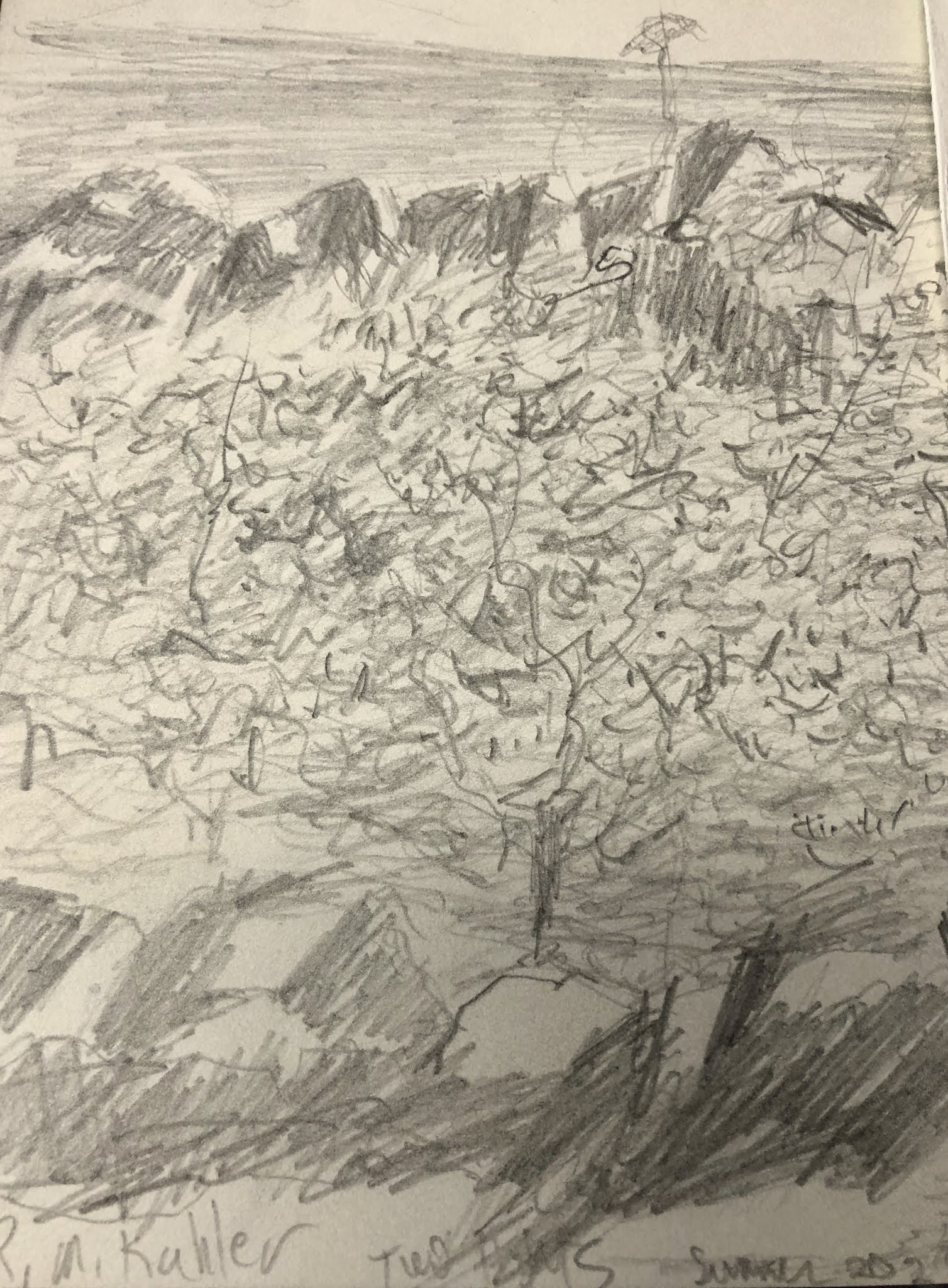
Although I don't have  any single process for creating a painting, this subject has progressed in a fairly typical way of late.  Spending time on location is always motivating.  I make a number of quick notes and sketches on note cards in addition to simply spending some time walking a location and observing.  I've begun using note cards for these sketches as they fit into a travel kit very easily.

Pencil notes from direct observation 4" x 5"

I then review a number of sketches and decide which subject to elaborate.  See below.

Pencil Comp Sketch
8" x 11"

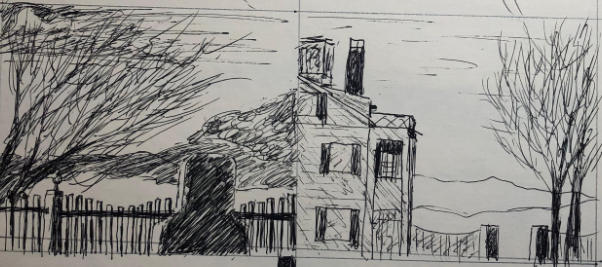
Years ago I had a happy accident when looking through some old sketches - they were on top of one another and at times created new and interesting compositions.  So I now will intentionally crop drawings to examine other possibilities.  When I'm on location, its still easy for me to get caught up in the scene and not seeing things from a perspective of composition.


When examining the two halves of the picture - I immediately settled on the right side of the composition as much stronger the whole composition as originally sketched.  The left side of the composition seemed much too static when viewed in this manner.

I plan to execute a number of paintings from this drawing including watercolor, acrylic, and oil.  I enjoy exploring different media as the unique qualities of each capture different elements of nature. 


watercolor sketching

I recently started experimenting with compositional sketches in watercolor.  Watercolor allows me to quickly block in a scene, experiment with color and different ideas for the subject.

The corner farm at dusk was just a quick impression I caught a glimpse of while driving home from work.   These sketches were only done in watercolor.


The second sketch of the corner farm is what it might look like as a winter scene with cornstalks as were actually there.  I changed the sky and moved the trees behind the house and moved the house further back in the composition.  I also extended the heighth of the silo.


From these quick small sketches I will continue to refine the paintings with more detailed studies (such as the corn stalks) before launching in to a finished painting.

All of these materials, a portable watercolor palette, a small water container and the watercolor paper scraps fit into a small sketch bag.  It's a quick ready to go at a moments notice.  I've put a couple of small watercolor brushes in a baggy along with pencil and charcoal should I desire to sketch in different media as well. 

Keeping these sketches "sketchy" will allow me to retain the enthusiasm necessary to continue to create and add throughout the process to the finished painting.

Color and Composition Study - Pemaquid


Color and Composition Study - Pemaquid ME

This study is graphite and gouache on paper - 12" x 18"   This painting is a combination of a variety of on location studies, pen and ink composition thumbnails, and represents a combination of views of the region that exist, but not exactly as in this composition.

Some quick notes from doing this study are to extend the tree on the left out of the picture, widen the gap between the river islands, and add a thin line of ocean beyond the mid ground to add some distance - that may also be another composition.  I was not too concerned with colors in this, more just trying to capture an impression.

I plan to do a large watercolor of this as well other media - oil, acrylic, and perhaps charcoal.

https://robertkahlerlandscapepaintings.blogspot.com/2020/03/composition-and-color-study-ammonusuc.html

Composition and Color Study Ammonoousuc River

I had to get out of the house for a bit yesterday.  Did a couple of quick pencil drawings of a farm outbuilding and of two huge maple trees on the farm.  For whatever reason, I seem to be going through a pencil drawing stage now.  There is something about capturing a scene in just shades of graphite that appeals to me.  Some pencil drawings are very delicate yet incongruously breathtaking and powerful at the same time (I'm not referring to my own work - yet).

Yet, this entry is actually not about pencil drawings, so I'll get back on point (pun intended).  Despite my current passion for pencil, I also regularly feel the urge to work with color, even in the design phase of my work.  So what follows is one two color and composition studies that I completed yesterday on 12" x 18" paper using graphite, gouache, and previous on location studies for reference and inspiration.

Ammonusuc River Study

I am still getting used to gouache - it seems to dry darker then when I paint it - whereas transparent watercolor tends to dry a little lighter.  Practice practice practice.  This scene was inspired by a hike (and sketch) along the river last April.  There was still ice and snow in the woods at this time and the river was running rapidly although the level had been dropping as evidenced by the trees and ice deposited along the riverbank far above the current water level.  When you see a large tree "deposited" in still standing trees fifteen feet over your head - its impossible not to be reminded of the power of nature and the respect it is due from us all.    I didn't paint those elements as I really wanted to focus on the river - but that is a subject that I will return to in the future.


The Sluice - composition deconstructed


"The Sluice"
Paper Mill Trail
Watercolor on Paper

This painting is an example of how I've taken different elements from an area to create a composition that isn't exactly what exists in nature, but which still honors the landscape and captures the feeling of the landscape that does exist.  My interpretation of the landscape, so to speak.

The basis of this painting was captured with an on location watercolor sketch (which looks little like this final composition)..  The tree covered hill to the left, the "pond" the sluice (right mid-ground) and the rapids are as was.

The stones in the foreground, do exist but would actually be out of sight to the left and below the edge of the field, forming the wall of one of the canals and a foundation for part of the mill..
The background of the picture, is actually an expanded view from upriver.  The actual view from this spot, wouldn't allow the viewer to go back into the picture.

Hopefully, this scene will feel familiar to those who are familiar with this Mill Street view in Lisbon.  But furthermore, hopefully this scene will touch the memories of those who have grown up near old industrial sites being reclaimed by nature.  If I've really done my job well, this picture will also appeal to people on its merits as a painting.


Too much to paint, too little time - Paris Hill

What do you do when confronted with Artistic Overload?  When every corner hides another dozen scenes to paint?

I suppose there are as many different answers to that question as there are people in the world.  For me, direct observation and sketching and painting from nature are key to my process.  However, there are simply times and circumstances where it is not possible to do either.  In those cases I will try to take a few pictures for later reference.  As soon as possible, I'll record my impressions with a sketch and sometimes a brief written description of what drew my attention to the subject - initially without even referencing the photograph.

The first time I went to Paris Hill was for a wedding at the church on the green.  If you've never been, it's well worth the trip and the effort to find it.  There used to be tours around Christmas of many of the historic houses.  I'm not sure if they still do that, but once again, worth it if they do.

Below are some small (3" by 4")  quick pen and ink sketches to explore different compositions and to develop a bank of historical house sketches for potential use in the future.  These particular sketches are all on a larger sheet of drawing paper sectioned off into 8 grids.


Paris Hill Impressions
               Church with Hannibal Hamblin House                         View from behind church toward
                              Pen and Ink 3" x 5"                                               village Pen and Ink 3" x 5"

                     Sunset and Distant Hills                                            Distant Hills, Sunset
                        Pen and ink 3" X 4"                                                 Pen and Ink 3"x 4"


New Englander - Pen and Ink 3" x 5"

I now really enjoy playing around with these sketches and compositions before launching into a painting.  It is time spent up front, but in the long run it is good practice and saves time from having to make large adjustments to a painting in progress.

Another thought I had while doing these sketches is to later take these sketches as a basis for finished sketches to have a unique momento of a place.  Many small sketches in the space of one larger sketch.

I hope you enjoy these impressions of Paris Hill.  In future posts I will share impressions of recent trips to Eastport and Cape Cod.

The link below will take you to some painting sketches completed in Eastport

https://robertkahlerlandscapepaintings.blogspot.com/2018/08/sea-glass-and-sketches.html


Lisbon Farm Charcoal


Here is the current state of the large charcoal of a nearby farm.  Below is the on location watercolor sketch and the very beginnings of this charcoal.  This drawing is relatively complete.  I'll do a little more work on the grass in the foreground, the sky,  and the pond in the mid ground but very few small adjustments.

I've added the pond and the rock wall to the composition.  Not original to the location, but as I worked on the sketch the idea occurred to me and is something I've seen throughout many New England Farms - including one in my hometown of Westbrook, Maine, at a classmates family farm (Wormell's).  I hope to go back to paint the farm pond there sometime soon if it is even still in existance.  

The pond in this drawing is another example of something that isn't there in reality, but is not so far out of place to be totally fictional or unrealistic.

I'll set this aside once completed but later use it as the basis for an oil painting.

Charcoal and Tracing Paper Experiments


I occasionally like to experiment with tracing paper.  Not to trace compositions, but I enjoy the feel charcoal on tracing paper.  Using tracing paper and even newsprint was also recommended by noted illustrators Robert Fawcett and Charles La Salle for practice.  I enjoy finding instructional books by artists such as these for inspiration.  Andrew Loomis is another favorite of mine.  The effects that Loomis and La Salle were able to achieve in Charcoal were amazing.  And Fawcett is an acknowleged master of line.  They make it look so easy.  Any expert does.  

I also like to see what the composition looks like in reverse.  While looking at a few of my paintings and drawings in preparation for entering another juried exhibition, I also noticed the difference the colored background makes.  

In this case I imagined a stormy sea where visibility was quite limited.  This was done from imagination, through I do enjoy storm watching along the coast.  The first image is simply with a piece of white paper behind the tracing paper charcoal drawing.


In the second picture, I've simply moved the white paper to the right and left the natural color of the drawing board (brown) to show through.  It does demonstrate a different mood.


The image below is with the image reversed.  Tracing paper makes this quick and easy - of course this can be done even more simply with basic computer software - but for me I prefer to go "old school"


 I'll share another example of working with watercolor on tracing paper in my next post.

I continue to be reminded on a regular basis that in art, and in life, there is no substitute for doing the work.  Reading about drawing or painting does no more to make you an artist than reading about playing the piano makes one a piano player.