Showing posts with label Watercolor. Show all posts

To the Sea Study


To the Sea
Study
Watercolor and Dry Brush

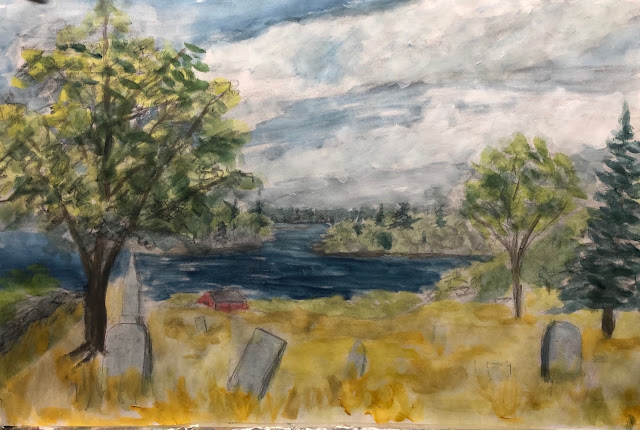
This small preliminary watercolor is drawn from my trips Down East and also to Pemaquid.  In this study I decided to simplify, by removing the cemetery from a larger earlier study (see below) and reducing the foreground trees to one large tree on the right.  I also was interested in trying to paint the foreground field using the dry brush technique. I also am trying different treatments with skies.  It's fun to just let loose with paint from time to time! (okay, actually all the time....).

Maine has so many peninsulas where the view to the ocean is still wild.  I find the contrast between the ochres of wild fields in the fall and spring and the blue of the ocean is striking   I find the views most interesting in spring, fall, and winter.  Summer has a beauty of its own but visually I find that  I'm more drawn to the play of light and reflections as the overall range of colors is reduced in the summer.

More and more development, means these views are not as plentiful as before, but the views are there if you take the roads less traveled.  


10 Annual Joy of Art Opening Reception

Julie and I aattended a woderful opening reception at the Crooker Gallery, Thopsham Public Library in Topsham Maine this afternoon.  It's always enjoyable to meet other artists and supporters of the arts and to see the many different expressions from different artists.  This Gallery and event is where I took my first steps to show my work outside the family (four years ago) and the staff was as warm, encouraging, and as welcoming as ever.

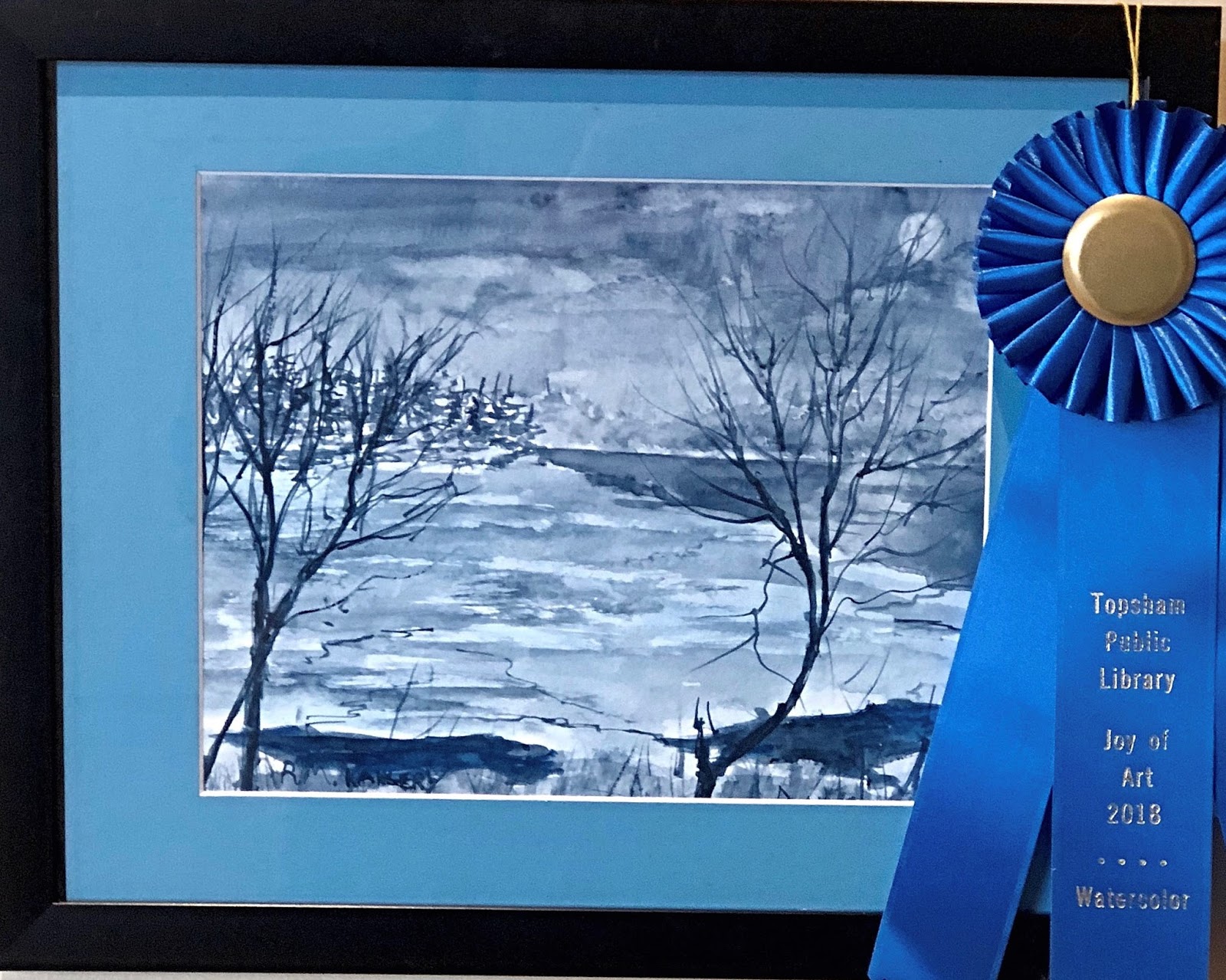
I entered two pieces in this juried exhibition.  A watercolor (Moonlight, Ice Out, Androscoggin) and an acrylic (Midcoast Marsh).

My watercolor, "Moonlight, Ice Out, Androscoggin" won first prize in the watercolor division.


I was speaking with another artist about her landscape painting, which I particularly admired, when a couple stopped by to listen to the conversation.  We spoke of the joys and challenges of painting on location and how it informs our work.  

The couple asked me what paintings I had entered in the show.   They then asked me to talk to them about my Midcoast Marsh painting.  I was able to describe to them the location which was the inspiration for the painting and about  my process for choosing and executing a subject.


"Would you consider parting with it?" and with that the painting was sold!  I'll write more about that soon.  It was so rewarding to hear the couple share their memories that my painting had stirred up of growing up in and around marshes and that Midcoast Marsh would have a home in thier cottage.

Thanks again to the Friends of the Topsham Public Library for this wonderful opportunity.


Stroudwater Colonial - Opening night


Here is a picutre of my charcoal "Stroudwater Colonial" which was accepted for the River Arts Gallery Exhibition - Black and White - Currently on display in Damriscotta.

My wife, Julie, also had two works accepted for this show - Her first juried exhibition!!  Congratulations honey!  Julie is gifted at avoiding having her picture taken, but that is another story.  It was a wonderful evening with family and new friends!


I'm submitting two paintings for jurying at the Crooker gallery in Topsham later this week.


Adroscoggin River, Ice Breaking by moonlight (watercolor)


Midcoast Marsh - Acrylic on Canvas Board

Crashing Surf


I am continuing to experiment with seascapes.  Despite spending many years along the coast, I still have a great deal of study to do to capture the power and movement and color of the sea.  This is a small watercolor with some use of chinese white as well as scaping with a razor blade to achieve some of the whites

This painting is not of an actual location, but is patterned after the rocks along the coast near Two Lights State Park in Cape Elizabeth Maine and Prouts Neck in Scarborogh, Maine.  

I've had the privilige of seeing a number of Winslow Homer's original paintings at the Portland Museum of Art as well as in Boston.  His seascapes are incredibly powerful - and make you feel as though you are really there on the cliffs by the sea.

Winslow Homer's studio is now owned by the Portland Museum of Art and tours are conducted on a regular basis.  The cliff walk around Prouts Neck is also open to the public.  Like many places in Maine, the trick is to find a place to park.  The cliff walk can be accessed from Scarborogh Beach which is an amazing beach by its own right.

Other artists whose work I admire in regard to sea scapes are John Stobart, Carl Evers, and Frederick Waugh to name a few.

As for the handling of water and light, I continue to be drawn to the works of Frank W. Benson, Aiden Lassell Ripley, and Ogden Pleissner.

I don't study other artists work too closely as I do not want to imitate anyone else.  However, there are times if I can not work out a solution to a problem that I will refer to other artists work if it's a situation where I can not physically go  to a location to work something out (for instance, if I'm working on a fall scene in the winter or vice versa).

Copying artists work in museums is also a time honored way of learning from previous masters.  You'll need to check with museums to see their policies and restrictions if you are interested in trying this.  I've never done it, but who knows, perhaps some day I will.  In a nutshell, any painting you do must be of a different dimension than the original so that there could be no danger any copy being confused for the original.


Evening Breaker #2


I've always loved the ocean.  The salt air, the sound of waves crashing on the rocks, the waves retreating back into the ocean rolling the rocks and sand.  A steady rythm, power,  and a vastness that seem to make everything else feel insignificant.

There are so many colors, both pure and reflected, and design elements that one could paint the same area of the coast day after day and never paint the same picture twice.  I particularly enjoy the coast during storms and other "off times."  

Though it has been many years, I still remember the power of the ocean when body surfing.  Literally being carried along, surprisingly fast by waves.  Learning to be patient and not to panic when held underwater by the power of the breaking waves.  The sting of salt water in my eyes and nose and the loud roar of the water of the breaker and the hiss of the wave stopping on the beach and retreating into the coming waves.

Below is a plein air seascape that I completed in Cape Elizabeth this past summer.


And a quick watercolor study from a sketch completed on location on Long Island, Maine.


Bowdoin Hillside Farm


This watercolor was created from an on location drawing trip to the neighboring town of Bowdoin.

I was struck by the hill rising and disappearing to the left - begging the question of what is around the bend and the contrast of the shadows spilling across the road and the field in the process of being plowed.

One of the things I've noticed in my travels throughout New England is how land is, or was, not wasted.  Rocky, sloping, and steep hilled land was, and in some cases still is farmed.  Toughness and persistence is required to earn a living in these conditions and climates.  I sense its far more of a calling than a business decision.

In Pennsylvania there is farmland as far as the eye can see.  So to it is here in Maine - the difference is the miles one can see in PA is so much greater as the land is so flat.  In Maine, in many places you will see a hayfield tucked in a corner of a property where the Spruce haven't yet found their way to the edge of a road.

The Spruce and Pine grow slowly, but are relentless.   When you drive along a road and there are many Birch and other opportunistic species of trees and few Pine and Spruce you know something has happened there - its not random.   Birch grow very fast, often after a fire or when land has been logged clear.   Pines and Spruce grow more slowly, but are relentless.  The acidic nature of their sprills also make it more difficult for other species of trees to survive.

Still the Pines and Spruce have their own charm.  I still vividly recall entering huge stands of Pine near my childhood home.  The undergrowth of the forest disappeared and their was an almost alienlike landscape of rust colored pine needles.  It was also so quiet until you heard the wind wistling through the pines.  So different than the sound of leaves rustling in the wind.

I only indicated a pine on the right of the painting.  The reality is that they dominated the road leading up to the farm.  The contrast betwen the dark spruce and open field was very dramatic.  One of the things I love about painting on location, is that the possibilities truly are endless.

A slight move up the road brings the farmouses into view and so many other subjects as well.  There was a tractor plowing when I was sketching so I'll try another version with that as well as fitting a sketch I did in PA with a horse and plow as well.


Sargent Watercolors

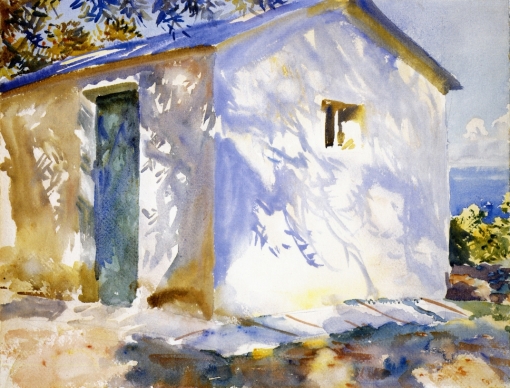
Corfu: Lights and Shadows by John Singer Sargent. (Watercolor on paper. 1909. Museum of Fine Arts, Boston.) Click to enlarge.


I saw a major show of John Singer Sargent's many years ago at the Boston Musuem of Art.  It included portraits and some of his work from World War One.  As is always the case, the original artworks were stunning beyond description - no matter how good the quality of reproductions.

In some cases, even in larger than life canvases - a single brushstroke "made the painting" come alive with light or shadow.

Personally, I've always been attracted to John Singer Sargent's watercolors from his travels thoughout the world.  In particular, his ability to capture a sense of light and atmosphere.  I have no idea of whether or not he ever intended to show his watercolors or if they were simply done for enjoyment or study purposes - I'm just glad that they have been preserved.

Even a mundane (or potentially mundane) subject comes to life under his brush.  A simple white building sparkles with light as seen below.


Bedouins

His ability to render whites in watercolor seems effortless - which no doubt came from years and years of study and experience plein air painting.

Like another artist I admire, Aiden Lassell Ripley, John Singer Sargent was not "stuck" on tradition. Even though much of thier commissioned work would likely be considered to be traditional, when traveling or painting for their own enjoyment, both artists painted beautiful yet substantial impressionistic watercolors.    Although the bulk of his watercolors appear to be translucent in nature, both Sargent and Ripley did utilize opaque watercolor (gouache) to achieve the highlights they desired.  It was the effect that was important - not the rules for getting "there."

Find your own way, study with moonlight


I've always been fascinated and drawn to the effects of moonlight.  It always seems so mysterious to me.  In particular, in the winter, a full moon and frozen ponds and marshes would expand the world I could explore as a child.  It opened up corners of the woods often closed off in different seasons.  Even very familiar places seem different at night, and moreso in the moonlight.

I also vividly remember the brilliance of the moonlight dancing on the ocean - particularly in the cold winter air.

Here is a study for the second in the planned series of Androscoggin River paintings.   A night scene.  I've thought about doing painting series of a particular scene for years now and occasionally I've done it but in a time period of years not weeks.  I'm not sure exactly what has motivated me to purposely paint and draw this series, other than the incrdedible contrast of this change of season from Winter to Spring.


This scene was done primarily with indigo with a few highlights/ darklights with prussian blue.  I do enjoy monochrome painting as it really forces me to focus on value and composition - errors in which can sometimes be masked with the use color.  There's still work to do on the composition.

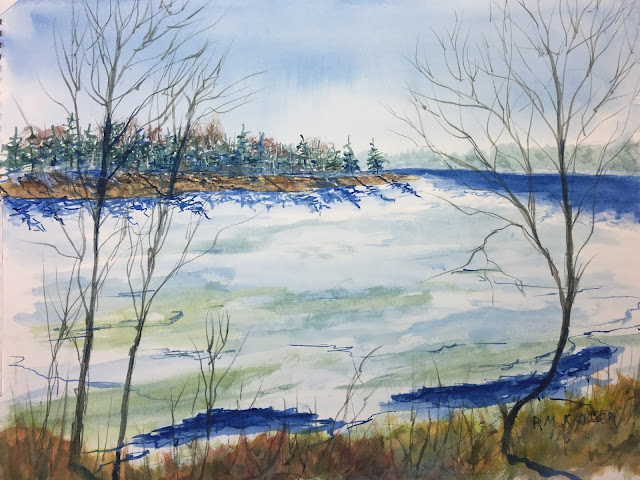
I've also been struck by the varied surface of ice on the river.  Some areas windswept reflecting light like a mirror - others still snow covered. The patterns of darker and lighter cracks in the ice definately lean to the abstract

One of the most common misperceptions about watercolor is that once you touch paint to paper, you cannot undo anything.  I've not found that to be the case - with very few exceptions.   You do have to plan your darkest darks and lightest lights out first but beyond that, I've found watercolor to be very flexible and suited to a wide variety of techniques.  Find your own way.  You certainly can learn from others but be confident and experiment - you will develop a style and method that is all your own.

What to do after an art show opening? Paint of course

Paint of course!


I enjoyed the opening of the show at River Arts last evening.  So many differnt artists, styles, and media.  I spent more time studying abstract works than I think I've ever done before.  I don't know if its because some of my latest subjects (winter / ice) have had an abstract quality about them or not.

Had a great dinner with Ari and Julie and when we got home I headed down to the studio and began work on a new watercolor based on earlier studies.   First Pass at compositional study.


First pass at larger watercolor last evening.


Then I referred back to the sketches made on location and took a quick trip back to the location for a few more details.  I went back to the comp study and indicated the foreground river bank and trees.  As well as some other work on hardwoods on the island.


Below is the final painting with those details mentioned above and some ice build up where the current continues to etch away at the ice.  Will not set this one aside for reconsideration later.  

I rarely decide if a painting is complete and ready for framing immediately.  I find some time and distrance from a paitning provides me with a "fresh look" at the subject.  I don't like to pick or fuss over a painting - and usually finish a painting in one or two sessions - but one never knows.


Long Island Sunset (Maine)


Long Island Maine, Sunset


My wife, then girlfriend, introduced me to Long Island Maine.  It's a small, but beautiful island, formally part of Portland, ME but it has since seceeded and become its own town.  We went out by mailboat and then walked to the other side of the island to a beautiful beach facing the open Atlantic. I found the water there to be very bracing compared to the beaches on the mainland.

There's a lot more history to explore on this island - it was a gathering and refueling point for convoys in World War II but that is a story for another time.

At the far end of the beach beyond the sand dunes and rocks is a beautiful house that has always captured my attention.


This was a very early drawing (charcoal pencil)

Years later, while chaperoning an 8th grade class trip to Long Island I completed the following two sketches for future reference, using the later as reference for the sunset watercolor.


The two sketches below were done on another trip.  It was a very windy day, as evidenced by the the beach sand stuck into the watercolor.


These sketches were all filed away for years.  At the time these were painted I didn't really have any deveoped working method.

Now, from time to time I'll revist sketches when conditions don't allow for painting on location. Below is an example of some small compositional sketches and notes and a quick color study that had an emphasis on the sky as I was quite interested to see what effect different perspectives would have on the mood of the painting.


There are many more subjects to pursue on long island, and this subject is far from complete.  The sketches are now back in storage (incubation).  I'm looking forward to taking more painting trips to the island in the near future.

I'd really like to set up on the beach for a good storm.....