Here you will find art for sale, journals and videos, as well as other sources of inspiration I've discovered along the way. The past 30 years of painting and the people I've met along the way have made an incalculable difference in my life. If you aren't already painting - get out and give it a try. you won't regret it.
Showing posts with label plein air. Show all posts
Bowdoin Hillside Farm
This watercolor was created from an on location drawing trip to the neighboring town of Bowdoin.
I was struck by the hill rising and disappearing to the left - begging the question of what is around the bend and the contrast of the shadows spilling across the road and the field in the process of being plowed.
One of the things I've noticed in my travels throughout New England is how land is, or was, not wasted. Rocky, sloping, and steep hilled land was, and in some cases still is farmed. Toughness and persistence is required to earn a living in these conditions and climates. I sense its far more of a calling than a business decision.
In Pennsylvania there is farmland as far as the eye can see. So to it is here in Maine - the difference is the miles one can see in PA is so much greater as the land is so flat. In Maine, in many places you will see a hayfield tucked in a corner of a property where the Spruce haven't yet found their way to the edge of a road.
The Spruce and Pine grow slowly, but are relentless. When you drive along a road and there are many Birch and other opportunistic species of trees and few Pine and Spruce you know something has happened there - its not random. Birch grow very fast, often after a fire or when land has been logged clear. Pines and Spruce grow more slowly, but are relentless. The acidic nature of their sprills also make it more difficult for other species of trees to survive.
Still the Pines and Spruce have their own charm. I still vividly recall entering huge stands of Pine near my childhood home. The undergrowth of the forest disappeared and their was an almost alienlike landscape of rust colored pine needles. It was also so quiet until you heard the wind wistling through the pines. So different than the sound of leaves rustling in the wind.
I only indicated a pine on the right of the painting. The reality is that they dominated the road leading up to the farm. The contrast betwen the dark spruce and open field was very dramatic. One of the things I love about painting on location, is that the possibilities truly are endless.
A slight move up the road brings the farmouses into view and so many other subjects as well. There was a tractor plowing when I was sketching so I'll try another version with that as well as fitting a sketch I did in PA with a horse and plow as well.
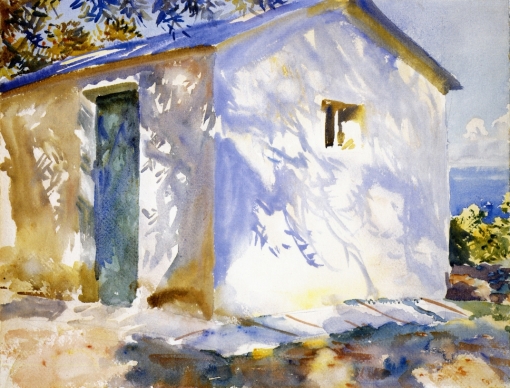
Sargent Watercolors

I saw a major show of John Singer Sargent's many years ago at the Boston Musuem of Art. It included portraits and some of his work from World War One. As is always the case, the original artworks were stunning beyond description - no matter how good the quality of reproductions.
In some cases, even in larger than life canvases - a single brushstroke "made the painting" come alive with light or shadow.
Personally, I've always been attracted to John Singer Sargent's watercolors from his travels thoughout the world. In particular, his ability to capture a sense of light and atmosphere. I have no idea of whether or not he ever intended to show his watercolors or if they were simply done for enjoyment or study purposes - I'm just glad that they have been preserved.
Even a mundane (or potentially mundane) subject comes to life under his brush. A simple white building sparkles with light as seen below.

Bedouins
Like another artist I admire, Aiden Lassell Ripley, John Singer Sargent was not "stuck" on tradition. Even though much of thier commissioned work would likely be considered to be traditional, when traveling or painting for their own enjoyment, both artists painted beautiful yet substantial impressionistic watercolors. Although the bulk of his watercolors appear to be translucent in nature, both Sargent and Ripley did utilize opaque watercolor (gouache) to achieve the highlights they desired. It was the effect that was important - not the rules for getting "there."
Approaching Abstraction?
One of the experiences I enjoy about painting on location is how strong an impression spending time observing nature leaves on me. I've written before about how what I observe can outpace what I'm able to achieve at the moment. This is especially true in unfamiliar locations.
What I've learned over time, is that there are two main things that I just need to let happen. Time - Time to interpret what I've seen, time to continue to develop my painting skills.
On location, there is a time pressure. Conditions change. The light changes dramatically in as little as half an hour. A change in light equals a change in colors. I choose to view these potential constraints as a benefit. It forces me to simplify the scenes. To emphasize what is essential, to subordinate what is not. If I were to compare this to writing, I'd say that painting on location is to studio paitning, what writing poetry or a short story is to writing a novel.
I've written before about a spot off Bear Notch Road. We've had a number of family visits and picnics on this spot. Our dog even went for her first swim here (impressive for a Shih-Tzu). Not sure a cold mountain stream was the best choice for that.
On Julie and my first trip to this spot I produced the following three sketches. The first is the view looking up stream.
The next sketch was a view just under the bridge looking upriver. The light was fading and almost choked out by the thick forest. The dark greenish/blue was the color of the reflections in the water. A few treetops were hit by the fading the light, most of the trees were in dark shade.
I was walking to take a last look at the mountains when I happened to look down at the water and I noticed the beautiful reflections in the water. Beautiful but fleeting. The slightest breeze made the reflections flutter and disappear. The result of that was a very quick unpacking on my paints and this very quick sketch. The bottom left is a quick indication of the shore and then the reflection of the mountain. The rest are the very briefest indications of beach in the river and the locations of visible shorelines.
What I've learned over time, is that there are two main things that I just need to let happen. Time - Time to interpret what I've seen, time to continue to develop my painting skills.
On location, there is a time pressure. Conditions change. The light changes dramatically in as little as half an hour. A change in light equals a change in colors. I choose to view these potential constraints as a benefit. It forces me to simplify the scenes. To emphasize what is essential, to subordinate what is not. If I were to compare this to writing, I'd say that painting on location is to studio paitning, what writing poetry or a short story is to writing a novel.
I've written before about a spot off Bear Notch Road. We've had a number of family visits and picnics on this spot. Our dog even went for her first swim here (impressive for a Shih-Tzu). Not sure a cold mountain stream was the best choice for that.
On Julie and my first trip to this spot I produced the following three sketches. The first is the view looking up stream.
The next sketch was a view just under the bridge looking upriver. The light was fading and almost choked out by the thick forest. The dark greenish/blue was the color of the reflections in the water. A few treetops were hit by the fading the light, most of the trees were in dark shade.
I was walking to take a last look at the mountains when I happened to look down at the water and I noticed the beautiful reflections in the water. Beautiful but fleeting. The slightest breeze made the reflections flutter and disappear. The result of that was a very quick unpacking on my paints and this very quick sketch. The bottom left is a quick indication of the shore and then the reflection of the mountain. The rest are the very briefest indications of beach in the river and the locations of visible shorelines.
To most, this simple sketch means little to nothing. A semi-abstract doodle. Speaking of abstract art. I was quite surprised to learn that one of my inspirations, the late Robert George Harris, experimented and explored with abstract art for years after he retired from a very successful carreer in illustration. He spoke of how this time absolutely informed his second career in portraiture. I don't pretend to understand abstract art. My earliest paintings tended to approach the abstract, which is not something I desired to explore; however, over time I have developed a tendancy to approach studio work with an initially abstract or semi-abstract design.
Julie and I had a neighbor years ago in Westbrook. She saw me painting outdoors and we both discovered our mutual interest in and our very different approaches to painting. I enjoyed our conversations about what inspired us to paint what we painted. Our approaches and choice of subject matter could not have been more different, but that didn't matter. They were a young couple and moved away a short time later. They made sure to stop by before they left and they gave me a gift of two art books that I still have in my collection, Boris Vallejo and Frank Frazetta.
This sketch takes me directly back to the time and place more than two decades ago. This will be the basis of a more finished painting eventually.
Julie and I had a neighbor years ago in Westbrook. She saw me painting outdoors and we both discovered our mutual interest in and our very different approaches to painting. I enjoyed our conversations about what inspired us to paint what we painted. Our approaches and choice of subject matter could not have been more different, but that didn't matter. They were a young couple and moved away a short time later. They made sure to stop by before they left and they gave me a gift of two art books that I still have in my collection, Boris Vallejo and Frank Frazetta.
This sketch takes me directly back to the time and place more than two decades ago. This will be the basis of a more finished painting eventually.
Subscribe to:
Posts (Atom)


