Showing posts with label working methods. Show all posts

To the Sea Study


To the Sea
Study
Watercolor and Dry Brush

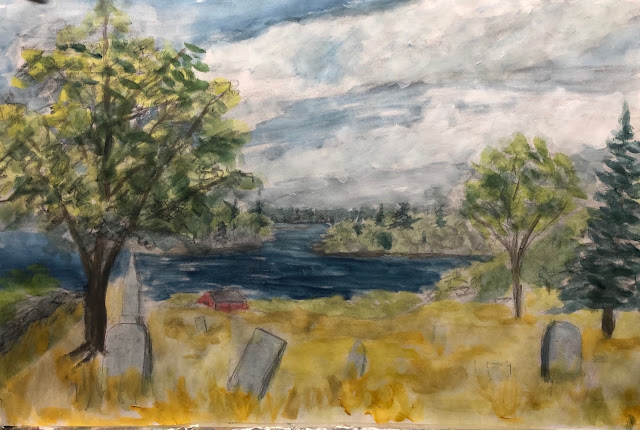
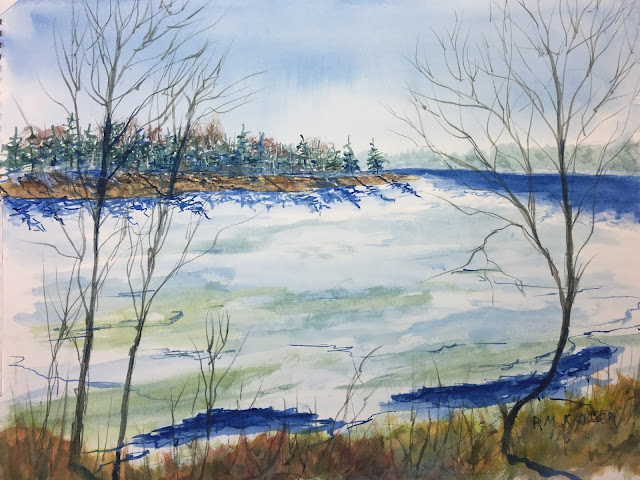
This small preliminary watercolor is drawn from my trips Down East and also to Pemaquid.  In this study I decided to simplify, by removing the cemetery from a larger earlier study (see below) and reducing the foreground trees to one large tree on the right.  I also was interested in trying to paint the foreground field using the dry brush technique. I also am trying different treatments with skies.  It's fun to just let loose with paint from time to time! (okay, actually all the time....).

Maine has so many peninsulas where the view to the ocean is still wild.  I find the contrast between the ochres of wild fields in the fall and spring and the blue of the ocean is striking   I find the views most interesting in spring, fall, and winter.  Summer has a beauty of its own but visually I find that  I'm more drawn to the play of light and reflections as the overall range of colors is reduced in the summer.

More and more development, means these views are not as plentiful as before, but the views are there if you take the roads less traveled.  


Country Church - Work in Progress

Do you have a favorite painting or drawing?


Here is my latest work in progress.  It's a small country church based on the watercolor below, which was completed on location years ago in Bowdoinham, Maine.   It's at a stage where I'll set aside awhile to see if there is anything else I'd like to add when I look at it with "fresh eyes" so to speak.


I had the good fortune to strike up a friendship and correspondence with the illustrator Bob Harris for the last decade of his life.  He was so generous with his advice and so encouraging.  He'd often laugh and say how difficult it was and how important it was  to know when a painting was done - before it was finished!  It's so easy to overcomplicate subjects and to leave little to the imagination for the viewer.

"Art is not what you see, but what you make others see."   Edgar Degas

I really do like this watercolor sketch below, not because of how it turned out or any technical learning from the painting.  It does have a special place for me because it was the first painting I'd done on location once we'd moved up to Lisbon Falls.  I have so many impressions and memories of trips up and down this road with so many more subjects to paint.


My favorite painting or drawing?  The next one!!

Below are a few quick compositional sketches for the charcoal drawing above.  I did these sketches within 5 minutes and then moved onto the charcoal.


I'll likely do some paintings based on the finished sketch as well.


Rugged Coast

Rugged Coast
Gouache on Paper

This painting is a gouache on paper over pen and ink.  As I've written about before, I will occasionally experiment over earlier paintings.  The Yankee in me hates to throw anything out.  Working in Gouache is still relatively new to me.  I prefer transparent watercolor, but whatever can help me achieve what I'm trying to achieve, I'll give it a try.

I was watching one of James Gurney's video's about painting on location with gouache and he mentioned how gouache tends to dry a little darker than it appears when painting - something I found to be very true.  This painting was also over a sketch in pen in ink with a lot of shading, so that did not help.  None the less, my plan was to go for a stormy scene anyway.

The picture below shows my current method for sketching on location and even studio work where I will work out different ideas in the margins - focusing on different compostions in thumbnail sketches before attempting a finished drawing.   


In this particular instance, there are only a few compositional sketches in the margins.  In other cases, the margins will be filled.   Another advantage of this method is for on location work.  At times, I may see a subject I want to paint, with many other elements that could lead to other paitnings in their own right, or some elements for me to add to other compositions.  It's a great practice that I also find forces me to simplify my compositions.  Initially I pre-drew all the squares for composition.  I've decided against that as there are times I'd like to do portrait orientation compositions as well as landscape compositions. 

I've not reached the point where I'm doing proportial sketches to the size of the final paintings, but that is easy enough to do.

Scarborough Barn by the Sea

This was the first pass (in charcoal) of a subject that began nearly two decade's ago.   It is not an exact representation of the subject but a composition of design elements that do exist, just not exactly in this configuration.


The process of choosing a subject, for me at least, is almost unconscious.  Sometimes it's an instant connection with a scene - often related to lighting, color or other effects of nature.   More often, its a place that I have a connection with through family, friends, or that I have visited or explored on my own.

This is a subject that began first as on location watercolor sketch.  Once the sketch was done, I set it aside as I often do.  I am energized by painting on location and this also gives me a backlog of subjects to explore further when getting out on location is not possible.  It is also just good practice of both oberservational skills as well as painting skills.

Yesterday, while Julie was shopping, I did a couple of studies (rough rough rough) studies of clouds. with watercolors.  Never intending for a full painting to appear, but as practice and perhaps elements that I'll use in later paintings.  It took me quite awhile to mature as a painter - I always wanted attempts to work out "right" and to produce finished works every time out.

I was watching a documentary on one of my favorite bands, The Eagles, and there was a segment that just made me laugh out loud and helped me to relax some too.  Glenn Fry was talking about being nervous about writing his own songs.  He was talking with some of his friends (Jackson Browne I believe) and he shared his secret fear when he was encouraged to write his own songs...

"What if they suck?"

"They will.  They will for awhile.  Just keep at it and one day they won't suck so much."

Thank God for perseverance.  So much beautiful music came to us through his efforts!  I was just reading about someone asking Walt Disney the "secret" to his success.  His answer was along the same lines.  "There is no secret.  You have to dog it.  Keep working at it day and night till its done and done right."

I've always enjoyed watching people I've worked with who have the passion to excel and who have put in the work to do so.  This group includes artists, muscians, teachers, heavy equipment operators, athletes, and more.   When someone is able to make something look easy - you can bet that it isn't and that a lot of practice and experience has gone into their work.

"The will to win is worthless without the will to prepare."   Thane Yost

Whatever your passion is - dive on in.

Scarborough Barn


This sketch is an elaboration of an on location watercolor completed in Scarborough Maine more than a decade ago.  This is one example of why I do enjoy the challenges of studio work from on location paintings.  

I hope to be able to take various elements that do exist (though not in this exact composition) in a place and bring them together into a scene that people feel as though they've been there.  In this case, the ocen in the distance with a small peninsula and a barn on a sloping hill tucked amongst elm, spruce, and other hard and softwoods encroaching on what was, at one time, a working farm.

The trees existed, but for the purposes of the picture I reversed them.  I'll do another color study as the original painting was done in the fall.  The Ocean was not viewable in the acutal setting due to the heighth of the surrounding forest but it would have been where I've indicated it in the drawing.

Baileys Island #2

Have spent the last couple of evenings/sunsets at Lands End on Bailey's Island.  It's amazing how different the sea is every day.  The first day the water was as smooth as glass and the reflection of the sunset was breathtaking.  Even got to watch a seal for awhile just off shore.

This sketch was completed from the parking lot.  It combines different elements that are present at Bailey Island, but not in the composition rendered below.  This composition combines the gnarled pine trees with rocks which dominate much of the landscape and on the horizon line is the lighthouse thats visible to the right of the island directly opposite the end of the road.

A sailboat happened by while I was sketching so I did a quick sketch of it, the outline of the memorial for those to who were lost at sea and the edge of the island with the lighthouse in the distance.

My wife laughed at me because, although I was at the seacoast I was sketching the pine trees in the parking lot - but that is sometimes how it works.  I found them to be so interesting visually that thatis what I was drawn to initially.

Am looking forward to painting some seascapes this fall and winter.


Old Country Church


Old Country Church
Pen and Ink 


I am fascinated by old churches.  The buildings and surrounding graveyards are full of so much history.   This drawing is an amalgamation of many churches and locations seen throughout my years of travel throughout New England.

If pressed, I would say the main inspriation for this drawing comes from the Spurwink Congregational Church in Cape Elizabeth, Maine (Built in 1802) and St. John. the Evangelist Church in Pembroke Maine, build circa 1855 by Irish immigrants who had come to work in the Pembroke Ironworks.

As I child I explored the church in Pembroke (it was left unlocked and open to any who wished to enter in those days) but at the time I was more fascinated by the surrounding grounds and cemetary.  The ground in front of the tombstones was depressed - where the old caskets had collapsed over time - and the thick woods surrounded the graveyard.  There was a bald eagles nest nearby.  I could never quite find it, but I saw the eagles for many many years patrolling the nearby Pennamaquan River which drains into Cobscook Bay.  It was a magical place to explore as a child.


Find your own way, study with moonlight


I've always been fascinated and drawn to the effects of moonlight.  It always seems so mysterious to me.  In particular, in the winter, a full moon and frozen ponds and marshes would expand the world I could explore as a child.  It opened up corners of the woods often closed off in different seasons.  Even very familiar places seem different at night, and moreso in the moonlight.

I also vividly remember the brilliance of the moonlight dancing on the ocean - particularly in the cold winter air.

Here is a study for the second in the planned series of Androscoggin River paintings.   A night scene.  I've thought about doing painting series of a particular scene for years now and occasionally I've done it but in a time period of years not weeks.  I'm not sure exactly what has motivated me to purposely paint and draw this series, other than the incrdedible contrast of this change of season from Winter to Spring.


This scene was done primarily with indigo with a few highlights/ darklights with prussian blue.  I do enjoy monochrome painting as it really forces me to focus on value and composition - errors in which can sometimes be masked with the use color.  There's still work to do on the composition.

I've also been struck by the varied surface of ice on the river.  Some areas windswept reflecting light like a mirror - others still snow covered. The patterns of darker and lighter cracks in the ice definately lean to the abstract

One of the most common misperceptions about watercolor is that once you touch paint to paper, you cannot undo anything.  I've not found that to be the case - with very few exceptions.   You do have to plan your darkest darks and lightest lights out first but beyond that, I've found watercolor to be very flexible and suited to a wide variety of techniques.  Find your own way.  You certainly can learn from others but be confident and experiment - you will develop a style and method that is all your own.

What to do after an art show opening? Paint of course

Paint of course!


I enjoyed the opening of the show at River Arts last evening.  So many differnt artists, styles, and media.  I spent more time studying abstract works than I think I've ever done before.  I don't know if its because some of my latest subjects (winter / ice) have had an abstract quality about them or not.

Had a great dinner with Ari and Julie and when we got home I headed down to the studio and began work on a new watercolor based on earlier studies.   First Pass at compositional study.


First pass at larger watercolor last evening.


Then I referred back to the sketches made on location and took a quick trip back to the location for a few more details.  I went back to the comp study and indicated the foreground river bank and trees.  As well as some other work on hardwoods on the island.


Below is the final painting with those details mentioned above and some ice build up where the current continues to etch away at the ice.  Will not set this one aside for reconsideration later.  

I rarely decide if a painting is complete and ready for framing immediately.  I find some time and distrance from a paitning provides me with a "fresh look" at the subject.  I don't like to pick or fuss over a painting - and usually finish a painting in one or two sessions - but one never knows.


Why I Love Plein Air Painting - Reason 1007

This morning started as just one of those mornings.  Got out of bed, stepped on the cat, )(the cat's fine), spilled morning coffee - you know the kind of day.  Nothing major, just irritating.

Later I took a short ride to see what was happening at the river bend today.  It was beautiful.  The sun was high, the ice was reflecting the sun, at times making difficult to see, the ice almost silver.  There were dark channels of open water working thier way through the ice pack creating a dramatic contrast to the silver ice and the trees were backlit so strongly they had an almost flat appearance.

More striking were the sounds of the day.  The wind blowing some stubburn   brittle brown leaves which had held on all winter.  When the wind held sustained gusts - you could observe the ice rolling ever so slightly, but it was the sound of the ice moving which really was the attention getter.

I did a very brief compositional study in Pen and Ink today.  Including a particularly interesting (to me) tree to be included in finished paintings.  I acutally spent more time taking some brief observational notes.


I began a large compositional sketch in charcoal a little while ago - just the very beginning of a sketch.  Then everything clicked.  The past few days of observation plus many random observations over the years.

From this one composition I'm going to do five subjects - which will all be different - and all based on my own observations of nature.  My own much simpler version of Monet's haystacks or Cathedrals.  Three daylight scences with differnet lighting as observed and two night scenes.  Am excited to get started.

The previous day, I'd done some four compositional studies from another vantage point.  They are sketchy (no pun intended) but turn out to be great time savers for me.  In a matter of minutes I was able to determine that an idea I had for a painting wouldn't really work as I'd envisioned it (rather than finding out at the end of a painting) and then eventually settling on a different composition to explore in more detail later.


Back to why I love painting on location - not simply the artistic problem solving - though that is satisfying by itself.  Most of all, the feeling of peace nature instills in me - no matter the day, no matter the time.

Approaching Abstraction?

One of the experiences I enjoy about painting on location is how strong an impression spending time observing nature leaves on me.  I've written before about how what I observe can outpace what I'm able to achieve at the moment.  This is especially true in unfamiliar locations.

What I've learned over time, is that there are two main things that I just need to let happen.  Time - Time to interpret what I've seen, time to continue to develop my painting skills.

On location, there is a time pressure.  Conditions change.  The light changes dramatically in as little as half an hour.  A change in light equals a change in colors.    I choose to view these potential constraints as a benefit.  It forces me to simplify the scenes.  To emphasize what is essential, to subordinate what is not.  If I were to compare this to writing, I'd say that painting on location is to studio paitning, what writing poetry or a short story is to writing a novel.

I've written before about a spot off Bear Notch Road.  We've had a number of family visits and picnics on this spot.  Our dog even went for her first swim here (impressive for a Shih-Tzu).  Not sure a cold mountain stream was the best choice for that.

On Julie and my first trip to this spot I produced the following three sketches.  The first is the view looking up stream.


The next sketch was a view just under the bridge looking upriver.  The light was fading and almost choked out by the thick forest.  The dark greenish/blue was the color of the reflections in the water.  A few treetops were hit by the fading the light, most of the trees were in dark shade.


I was walking to take a last look at the mountains when I happened to look down at the water and I noticed the beautiful reflections in the water.  Beautiful but fleeting.  The slightest breeze made the reflections flutter and disappear.  The result of that was a very quick unpacking on my paints and this very quick sketch.  The bottom left is a quick indication of the shore and then the reflection of the mountain.  The rest are the very briefest indications of beach in the river and the locations of visible shorelines.


To most, this simple sketch means little to nothing.  A semi-abstract doodle.  Speaking of abstract art.  I was quite surprised to learn that one of my inspirations, the late Robert George Harris, experimented and explored with abstract art for years after he retired from a very successful carreer in illustration.  He spoke of how this time absolutely informed his second career in portraiture.    I don't pretend to understand abstract art.   My earliest paintings tended to approach the abstract, which is not something I desired to explore; however, over time I have developed a tendancy to approach studio work with an initially abstract or semi-abstract design.

Julie and I had a neighbor years ago in Westbrook.  She saw me painting outdoors and we both discovered our mutual interest in and our very different approaches to painting.  I enjoyed our conversations about what inspired us to paint what we painted.  Our approaches and choice of subject matter could not have been more different, but that didn't matter.  They were a young couple and moved away a short time later. They made sure to stop by before they left and they gave me a gift of two art books that I still have in my collection, Boris Vallejo and Frank Frazetta.

This sketch takes me directly back to the time and place more than two decades ago.  This will be the basis of a more finished painting eventually.  


Here are a couple of sketches done years later in studio using these on location sketches and memories as reference.  More on these in later posts.

Long Island Sunset (Maine)


Long Island Maine, Sunset


My wife, then girlfriend, introduced me to Long Island Maine.  It's a small, but beautiful island, formally part of Portland, ME but it has since seceeded and become its own town.  We went out by mailboat and then walked to the other side of the island to a beautiful beach facing the open Atlantic. I found the water there to be very bracing compared to the beaches on the mainland.

There's a lot more history to explore on this island - it was a gathering and refueling point for convoys in World War II but that is a story for another time.

At the far end of the beach beyond the sand dunes and rocks is a beautiful house that has always captured my attention.


This was a very early drawing (charcoal pencil)

Years later, while chaperoning an 8th grade class trip to Long Island I completed the following two sketches for future reference, using the later as reference for the sunset watercolor.


The two sketches below were done on another trip.  It was a very windy day, as evidenced by the the beach sand stuck into the watercolor.


These sketches were all filed away for years.  At the time these were painted I didn't really have any deveoped working method.

Now, from time to time I'll revist sketches when conditions don't allow for painting on location. Below is an example of some small compositional sketches and notes and a quick color study that had an emphasis on the sky as I was quite interested to see what effect different perspectives would have on the mood of the painting.


There are many more subjects to pursue on long island, and this subject is far from complete.  The sketches are now back in storage (incubation).  I'm looking forward to taking more painting trips to the island in the near future.

I'd really like to set up on the beach for a good storm.....


After the Storm, Lisbon Falls


After the Storm, Lisbon Falls
Acrylic 12" x 16"

This acrylic was painted the same day I completed an on location sketch - while the composition and colors were fresh in my mind.  This was from a winter or two ago.  Big storm coming in, up to another two feet of snow.  Am looking forward to seeing the results of the storm (but not to shoveling out).

I was struck by the color of the ice and the trees all being weighed down by snow and ice.  The scene changed quite quickly once the sun worked its way through the clouds melting the ice and snow.

Another thing that I enjoy about painting on location is that I observe things that I wouldn't know to make up or to include in a purely studio based painting.  For instance, in the painting the lines of snow (cracks in the ice) help compositionaly, but it also indicates how hard the wind had been blowing (snow off the ice) and also that the ice freezes in different locations at different times.


Night in Windham


Night in Windham
Acrylic 12" x 16"

This is my first attempt at an on location painting at night.  I learned a lot - the usual mixture of things to do and things not to do next time.  I'm sure I broke pretty much every "rule" about painting night scenes - but I had a blast.  Overall the picture came out too dark.  

I'll definately use this painting as the basis of numerous other subjects - combining elements that were present in the scene or others that I've witnessed in other settings.  I'll do some thumbnail sketches to try different compositions and then perhaps some tonal sketches before developing ideas further.  This type of studio work after doing on location paintings I've grown to enjoy very much.  

Some examples include - a barn with a snow covered roof catching the light of the moon;  The acutal barn is a quanset hut, but I would change that to an old barn (many different styles to choose from);

A scene with the moon rising above the trees, providing dramatic back lighting as I observed throughout the earlier evening.  By the time I painted this, the moon was high in the sky and obscured by clouds.

Other possible iterations could include animals in the moonlight or , as can often be seen at this time of year, skiers or snowmobiles in the far field.

This painting was also done on a canvas I primed with gesso and then a coat of burnt sienna.  It made it easy to quickly cover the canvas - but it also may have contributed to the overall darkness of the painting.  I'll experiment on future paintings with the effects of undercoating color on the overall painting.

Below is a photo of my paintbox with the pallette looking a bit abstract.