Showing posts with label Maine. Show all posts

To the Sea Study


To the Sea
Study
Watercolor and Dry Brush

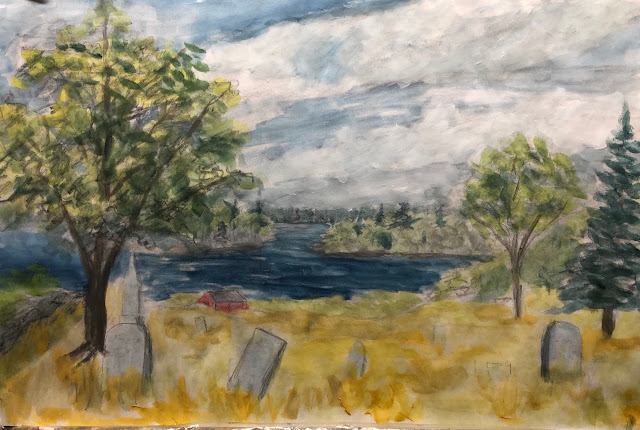
This small preliminary watercolor is drawn from my trips Down East and also to Pemaquid.  In this study I decided to simplify, by removing the cemetery from a larger earlier study (see below) and reducing the foreground trees to one large tree on the right.  I also was interested in trying to paint the foreground field using the dry brush technique. I also am trying different treatments with skies.  It's fun to just let loose with paint from time to time! (okay, actually all the time....).

Maine has so many peninsulas where the view to the ocean is still wild.  I find the contrast between the ochres of wild fields in the fall and spring and the blue of the ocean is striking   I find the views most interesting in spring, fall, and winter.  Summer has a beauty of its own but visually I find that  I'm more drawn to the play of light and reflections as the overall range of colors is reduced in the summer.

More and more development, means these views are not as plentiful as before, but the views are there if you take the roads less traveled.  


Country Church - Work in Progress

Do you have a favorite painting or drawing?


Here is my latest work in progress.  It's a small country church based on the watercolor below, which was completed on location years ago in Bowdoinham, Maine.   It's at a stage where I'll set aside awhile to see if there is anything else I'd like to add when I look at it with "fresh eyes" so to speak.


I had the good fortune to strike up a friendship and correspondence with the illustrator Bob Harris for the last decade of his life.  He was so generous with his advice and so encouraging.  He'd often laugh and say how difficult it was and how important it was  to know when a painting was done - before it was finished!  It's so easy to overcomplicate subjects and to leave little to the imagination for the viewer.

"Art is not what you see, but what you make others see."   Edgar Degas

I really do like this watercolor sketch below, not because of how it turned out or any technical learning from the painting.  It does have a special place for me because it was the first painting I'd done on location once we'd moved up to Lisbon Falls.  I have so many impressions and memories of trips up and down this road with so many more subjects to paint.


My favorite painting or drawing?  The next one!!

Below are a few quick compositional sketches for the charcoal drawing above.  I did these sketches within 5 minutes and then moved onto the charcoal.


I'll likely do some paintings based on the finished sketch as well.


Crashing Surf


I am continuing to experiment with seascapes.  Despite spending many years along the coast, I still have a great deal of study to do to capture the power and movement and color of the sea.  This is a small watercolor with some use of chinese white as well as scaping with a razor blade to achieve some of the whites

This painting is not of an actual location, but is patterned after the rocks along the coast near Two Lights State Park in Cape Elizabeth Maine and Prouts Neck in Scarborogh, Maine.  

I've had the privilige of seeing a number of Winslow Homer's original paintings at the Portland Museum of Art as well as in Boston.  His seascapes are incredibly powerful - and make you feel as though you are really there on the cliffs by the sea.

Winslow Homer's studio is now owned by the Portland Museum of Art and tours are conducted on a regular basis.  The cliff walk around Prouts Neck is also open to the public.  Like many places in Maine, the trick is to find a place to park.  The cliff walk can be accessed from Scarborogh Beach which is an amazing beach by its own right.

Other artists whose work I admire in regard to sea scapes are John Stobart, Carl Evers, and Frederick Waugh to name a few.

As for the handling of water and light, I continue to be drawn to the works of Frank W. Benson, Aiden Lassell Ripley, and Ogden Pleissner.

I don't study other artists work too closely as I do not want to imitate anyone else.  However, there are times if I can not work out a solution to a problem that I will refer to other artists work if it's a situation where I can not physically go  to a location to work something out (for instance, if I'm working on a fall scene in the winter or vice versa).

Copying artists work in museums is also a time honored way of learning from previous masters.  You'll need to check with museums to see their policies and restrictions if you are interested in trying this.  I've never done it, but who knows, perhaps some day I will.  In a nutshell, any painting you do must be of a different dimension than the original so that there could be no danger any copy being confused for the original.


Evening Breaker #2


I've always loved the ocean.  The salt air, the sound of waves crashing on the rocks, the waves retreating back into the ocean rolling the rocks and sand.  A steady rythm, power,  and a vastness that seem to make everything else feel insignificant.

There are so many colors, both pure and reflected, and design elements that one could paint the same area of the coast day after day and never paint the same picture twice.  I particularly enjoy the coast during storms and other "off times."  

Though it has been many years, I still remember the power of the ocean when body surfing.  Literally being carried along, surprisingly fast by waves.  Learning to be patient and not to panic when held underwater by the power of the breaking waves.  The sting of salt water in my eyes and nose and the loud roar of the water of the breaker and the hiss of the wave stopping on the beach and retreating into the coming waves.

Below is a plein air seascape that I completed in Cape Elizabeth this past summer.


And a quick watercolor study from a sketch completed on location on Long Island, Maine.


Bowdoin Hillside Farm


This watercolor was created from an on location drawing trip to the neighboring town of Bowdoin.

I was struck by the hill rising and disappearing to the left - begging the question of what is around the bend and the contrast of the shadows spilling across the road and the field in the process of being plowed.

One of the things I've noticed in my travels throughout New England is how land is, or was, not wasted.  Rocky, sloping, and steep hilled land was, and in some cases still is farmed.  Toughness and persistence is required to earn a living in these conditions and climates.  I sense its far more of a calling than a business decision.

In Pennsylvania there is farmland as far as the eye can see.  So to it is here in Maine - the difference is the miles one can see in PA is so much greater as the land is so flat.  In Maine, in many places you will see a hayfield tucked in a corner of a property where the Spruce haven't yet found their way to the edge of a road.

The Spruce and Pine grow slowly, but are relentless.   When you drive along a road and there are many Birch and other opportunistic species of trees and few Pine and Spruce you know something has happened there - its not random.   Birch grow very fast, often after a fire or when land has been logged clear.   Pines and Spruce grow more slowly, but are relentless.  The acidic nature of their sprills also make it more difficult for other species of trees to survive.

Still the Pines and Spruce have their own charm.  I still vividly recall entering huge stands of Pine near my childhood home.  The undergrowth of the forest disappeared and their was an almost alienlike landscape of rust colored pine needles.  It was also so quiet until you heard the wind wistling through the pines.  So different than the sound of leaves rustling in the wind.

I only indicated a pine on the right of the painting.  The reality is that they dominated the road leading up to the farm.  The contrast betwen the dark spruce and open field was very dramatic.  One of the things I love about painting on location, is that the possibilities truly are endless.

A slight move up the road brings the farmouses into view and so many other subjects as well.  There was a tractor plowing when I was sketching so I'll try another version with that as well as fitting a sketch I did in PA with a horse and plow as well.


Clouds Over Mountan Pond


This charcoal is 12" x 16" with a few highlights of gouache

Working in the studio today.

The bulk of this drawing was completed years ago and set aside.  That is something I will do from time to time.  Sometimes its because I've reached the point in a subject that I've reached the limit of my technical skills (In other words, I know what I want to achieve but I don't know how to do it yet) ,  More often than not, its because I am most inspired by source material (aka nature) so I'll work on a number of subjects at once leaving studio work for later.  

 I decided to experiment with this subject, adding to and changing the composition of the clouds, shadows on the mountains and reflections in the pond and some general touch up.

I also pursued some experimentation with tracing paper, pen and ink, on an oil composition of an Amish Farmer.  The two sketches below are future projects.  The top sketch is a compositional study for continued work on the oil of an Amish Farmer.  More on that subject in different posts.

The drawing below was also completed years ago.  A snowy hillside in Lewiston.  My next studio day of experiementation will involve this subject. 


Study Ice Breaking - Androscoggin River parts B and C


This large charcoal (18" by 24") was done to expand upon the small pen and ink sketch done from on location observations.  I added a few elements such as the additonal open water in the foreground.  The next step was the color compositional study below.


This compositional study (9"x 12") was a double experiment for me - one in terms of subject matter.  Had never attempted an ice dominated subject before - am quite excited about the possibilities.  It's a short season but one that, for me, demands more study.

This was also an experiment in terms of ground for the painting.  I used a watercolor block for this.  I was pleasantly surprised at how even a lighter weight paper (in this case 140 lb paper) didn't buckle.  I'll definately continue to utilize watercolor blocks, particularly for on location paintings.

I decided to leave the foreground as is for now - time will tell.  In some ways I like it better, but I think it creates a weaker composition...  Need to give it time.