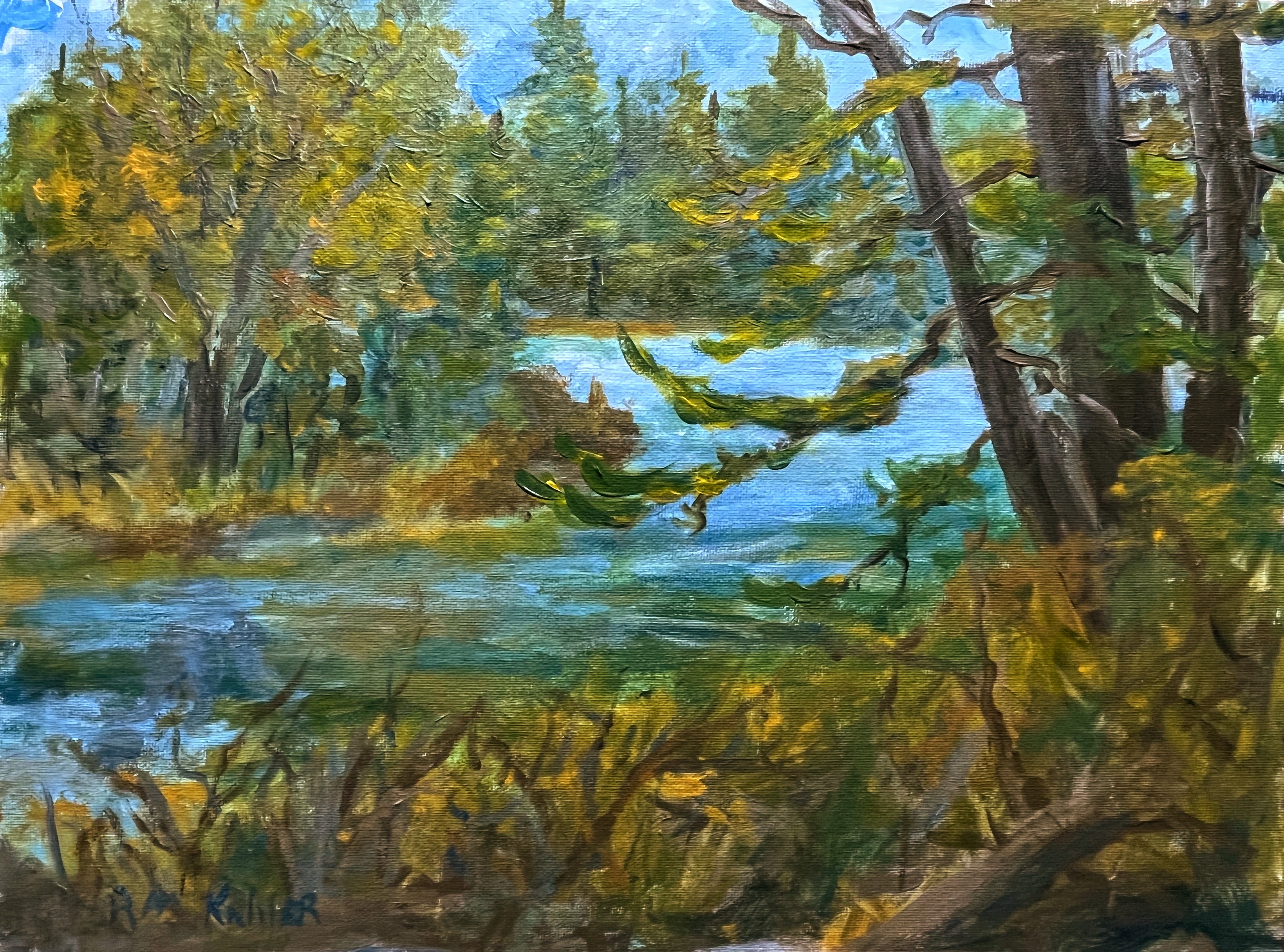
Beaver Pond Reflections


Beaver Pond Reflections - Crawford Maine
Acrylic 12" x 16"


Below left was the painting before final adjustments for color and composition.  Subtle differences in the height of the background trees.  I developed the trees on the island and the shape of the island a bit more and, lastly, added some detail and color contrast to the pond, reflections, and foreground.

I particularly enjoyed painting the foreground.  When exploring the Maine streams and woods in the summer or fall, you will often see trees and driftwood deposited by the spring runoff  high among trees or high up on river banks.  That was the inspiration for the tree in the lower right foreground.   A small thing, an incidental accident, almost unconscious but as soon as I made the first brushstroke - there it was.  


The other challenge I run into when painting is to find the proper balance of detail and impression.  I prefer letting the imagination fill in detail whenever possible.

While reading a book of Rusty Heurlin's with his notes in the margins - he had underlined and noted the importance of simplification in his work.  "Simplify, Simplify, Simplify....   Put in only what is necessary in a picture and no more."

Easier said than done but the experimentation is fun and remember - there is almost nothing that can't be undone!


Process versus Spontaneity


Acrylic 12" x 16"

This is an update on the progress of Beaver Pond - Crawford.   This represents about 45 minutes of work with Acrylic directly on canvas to block in the composition and then about 10 minutes on another day to begin to zero in on correcting colors.  (2nd pass)

My favorite type of painting remains on location painting, starting and finishing in one session - generally about two to two and a half hours.  However,  when I don't have the time to paint on location I'll use on location sketches and trips as inspiration.  I've documented this elsewhere if you are interested.

In general my method in these types of cases for acrylics is

Compositional Sketches (very loose - mostly line drawings)
Larger Charcoal Sketch to work on values

Then onto working with Paint:

1st Pass  Covering the Canvas in Paint
                    Blocking in the composition rapidly
                    While attempting to get colors and values correct at this stage - but 
                     not worrying if the colors are off 

2nd Pass  Fine tuning painting for both color and composition

Set aside for a few days (or months or years in some cases)

3rd Pass (if painting is not completed) further refinement


I resisted developing a system or process for years.  I just wanted to get out and paint.  While that helped me develop as an artist in many ways, it was also frustrating for me as I often spent as much time searching for what I needed, often wasting what little time I had for painting.  

I've slowly come to realize that even on a day when nothing goes as planned with a painting, if the results are horrible and in no way reflect what I am trying to capture - it's fine.  I still have learned something.  

It took me years to establish a system that works for me with the time I have that still allows me to maintain a sense of spontaneity and excitement when I'm painting.

I also have a "go bag" (three actually) for Watercolor, Acrylic, and Charcoal in addition to my main paintbox which I will switch out between all of the above and oil paintings.


Fall Reflections by Elmer Ham


Watercolor by Elmer L Ham

I love the light and the sense of atmosphere captured by Ham in this watercolor painting.  While this is likely a painting executed in studio - it clearly demonstrates to me the lifetime Ham spent studying nature and painting and sketching on location.

This is most likely a Maine or Massachusetts scene by Ham.  I've seen landscapes and florals executed by Ham in Watercolor, Pastel, Oil, and Pencil.  

Working as a sign painter and painting outdoor advertising murals allowed Ham to pursue his love of painting throughout his life.  Ham exhibited paintings in Boston, Provincetown, and Springfield Mass, and Ogunquit and York Maine as well as in competitions and local venues throughout New England and California.