abstract seascape study


Here is another full sheet watercolor study by Elmer L. Ham.   The pictures don't do it justice.  It has an almost abstract quality about it.  It strikes me as another on location study.  Faint pencil lines block in both the major masses of rocks (Feels more like California than Maine to me) as well as of the wave action - see below.


The sense of movement is captured and the white of the paper also is utilized effectively to capture whitecaps as well as foam from waves crashing on rocks.  It all implies to me a familiarity with the ocean as well as this particular location.  That is only reinforced by the deft strokes of a loaded brush throughout the painting.  

This strikes me as a rapidly executed sketch (you have a max of a couple of hours before the light changes too much - and my reality of painting along the coast is that you tend to have a shorter window).  But everything is contained within this first pass to allow the artist to go back at any time to finish the painting or to use this as a basis for a finished painting.

I will show more of his completed seascapes in future posts but I enjoy sharing some of my interpretations of the artists thinking.  They are not complete but , for me, the sense of movement is there and I can hear the surf (it could be the tinnitus but I prefer to think it is the surf)

Elmer Ham Fishing Boats


Sketch of Fishing Boats - Watercolor by Elmer L. Ham
8.5" x 10" Sight Size
11" x 14" Framed

There is a quality about a sketch that I particularly enjoy.  You get to see the artists thinking and focus as they work.  What the artist finishes and what the artist leaves out is often telling. 

To me, this study is one of light, shadow, and reflection.  Note how the shading on the boats add depth and form.   On the near boat, how the shadow and rust on the way below deck add form and substance.  The shadows on the second boat on the fishing nets the shadows from the fishing nets on the small boat in between the larger boats.

Also, note the reflections in the foreground, they are not static.  They are fluid and evoke the feeling of moving water. This is the result of years of observation.  Whether or not this was done on location, I have no proof, but it is too close to the subject to have been done as an exercise or from a photograph.

The pencil lines for rigging again are not perfectly taut but as one would find on a working boat in harbor.  The lines for the wharf also frame the composition nicely.  If the wharf were added, it might well distract from the ships.  This may have well been why the sketch was not completed - but there could also be a hundred other reasons.  I do know, from the paintings I have in my possession, that Ham would often return to a subject to emphasize a different aspect of the painting or to tighten up the composition.  Another plausible explanation of why this subject was not completed could have been that it had simply served its purpose for Ham and he kept it for further reference.

I decided to mat and frame this sketch.  I'll replace the white mat with a colored mat to bring out more of the colors within the boats to tie everything together.


Sketch of Fishing Boats - Watercolor by Elmer L. Ham
8.5" x 10" Sight Size
11" x 14" Framed

Floral Still life Fragment by Elmer Ham


Elmer L Ham Watercolor  5" x 7" framed.

This is a fragment of an unfinished floral watercolor by Elmer L Ham.    In addition to many finished paintings, the portfolios of paintings I purchased had many paintings in various stages of completion.  There were many finished still lives, others that were clearly studies of floral still life in watercolor and pastels and still others that were started but not finished beyond the pencil sketch (outline really) and some areas of finish.  

You can see the faint pencil indications in this sketch - which would be erased partially or completely in finished painting depending on the artists decision on whether the pencil added to or distracted from the desired effect.

I gave much consideration to the uncompleted still lives.  Many studies were on full sheets of watercolor paper - too large to be displayed with so much unfinished and all unsigned.  After studying the paintings intently, I decided to experiment and crop, mat, and frame some of the more finished pieces.  The above painting is one example of those efforts.

I have to admit, still lives had not held much appeal to me - being far more interested in landscapes.  But I'd never taken the opportunity to study so many up close.  I've also been considering doing still lives of items of loved ones no longer with us.  My parents, and my sister Cathy to name a few.  I also found the process of considering different compositions from different paintings to be a very engaging activity.


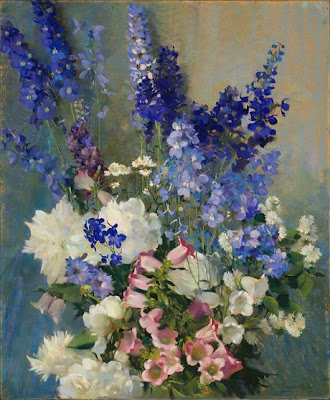
Ham's teacher, Laura Coombs Hills, was and still is very well known for her still life floral paintings in both pastel and oils.  She would summer in the town of her birth, Newburyport Mass, often picking flowers from her own garden and painting them.  She would then move to her winter studio in Boston, Ma. When speaking with the curator of a recent retrospective of Hills, she stated that Hills did teach occasionally and only select students as she was actively painting, exhibiting, and selling through galleries.  There are many other areas where Hills was a recognized expert but that is a subject for another time.

Image result for laura coombs hills painting  
     by   Laura Coombs Hills
                                                               Laura Coombs Hills

How and when she met and decided to teach Ham I haven't been able to determine at this time.  She definitely had an influence on him, as evidenced by his exhibition of a floral still life in the Annual Exhibition of New England painters at Jordan Marsh Galleries in Boston in 1946 and the many still life paintings in his portfolios.  

Interestingly, I did find an old newspaper clipping, describing how a young teenage Elmer L Ham left his home in Portsmouth NH to "see the world" (without his parents knowledge).  Ham slept overnight in a barn and was discovered the following night wandering around the Market Square in Newburyport.  Maybe that spirit of adventure was remembered and noted by Hills - as the journey did make the papers.  Ham's father collected him safely the following day, thanking the police for their kindness.

Throughout his life, Ham explored and painted along the Maine, NH, and Massachusetts coast as well as the California coast.  Ham definitely captured the movement of water and the action of waves and mist - which only comes from long study and observation.  His California seascapes capture a different atmosphere that I've never had the pleasure of visiting, but compared with other known California Artists, he's captured the West Coast as surely as he did the East Coast.